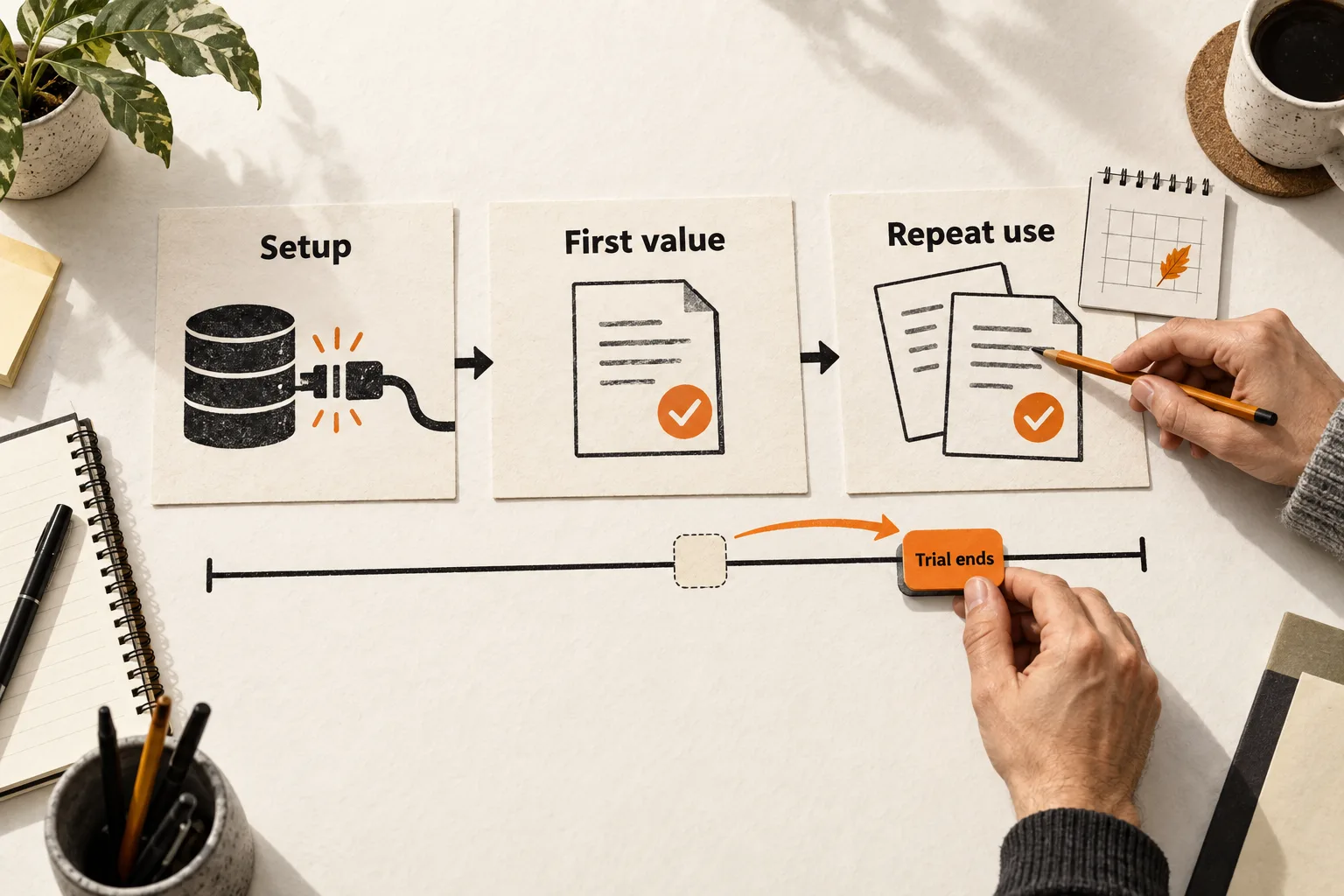
Choose your SaaS free trial length by mapping the work a buyer needs to complete: setup, a useful first result, and enough repeated use to evaluate the product. That map gives you a duration worth testing, though it cannot predict which duration will convert best.
Suppose a buyer signs up on Tuesday, connects their data on Friday, and gets a useful result the following Monday. A seven-day trial leaves little time to check that result on another task. The question to investigate is which unfinished activity would justify more time.
Define what the buyer needs to prove
Start with one customer segment and one recurring job. A solo founder evaluating an AI writing tool has a different schedule from an operations team connecting a workflow to company systems.
An evaluation goal might be: “The operations lead can process a real request, inspect the output, and repeat the task without our help.” Account creation tells you little about whether the buyer has reached that goal.
For an AI product, include the work after generation. A buyer may need to check accuracy, correct mistakes, compare the result with their current process, and decide whether the review effort is acceptable. Define first value as a result the buyer accepts for the intended task.
Ask recent trial users what they were trying to finish, what delayed them, and what remained unproven when access ended. Include people who stopped using the product. Keep their words separate from your interpretation. You can adapt the fields in FindVex’s pain-point evidence sheet to organize those observations and unanswered questions.
Map setup, first value, and repeated use
For each account, record elapsed calendar time from signup to these milestones:
| Milestone | Evidence to record |
|---|---|
| Setup complete | Real data or a necessary integration is ready |
| First value | The buyer accepts a useful result |
| Repeated value | The buyer completes another relevant task |
| Evaluation complete | The buyer can explain what worked and what did not |
If your trial runs continuously from signup, weekends, meetings, and delayed invitations all consume evaluation time. Record hands-on effort separately where possible. Ten minutes of setup spread across four days calls for a different response from four days of technical work.
Inspect individual paths before calculating a typical time. Keep accounts that never reached a milestone visible, with the last step completed and any known obstacle. An average based only on successful users leaves out those who got stuck.
Classify delays by cause. A broken import needs a product fix; an unclear next step needs better onboarding. A weekly reporting task needs another reporting date. A buyer who has finished evaluating but lacks purchase approval may need a separate buying conversation.
Before adding days, name the activity those days would enable. If you cannot, investigate the obstacle first.
Choose two durations that fit the evaluation
Use the elapsed time from signup to a credible repeat result, plus time for the buyer to review it, as a planning estimate. Avoid counting overlapping work twice: a teammate may review one result while another workflow runs.
These are starting hypotheses, not benchmarks:
| Candidate duration | When it may fit |
|---|---|
| Seven days | Setup and useful repeated work can happen within the week |
| Fourteen days | Evaluation requires another weekly work cycle or a teammate’s participation |
| Thirty days or a scheduled evaluation | Implementation or a monthly task makes a shorter window unrealistic |
Competitor offers can suggest candidates, but they do not establish what works for your customers. As checked September 27, 2026, Jira Premium’s FAQ lists seven days for new customers and a fixed thirty-day evaluation for annual subscriptions, with separate terms for existing customers. These are offer terms, not conversion evidence. Atlassian’s Jira Premium FAQ.
Longer access can add support and processing costs and postpone payment decisions. Shorter access may exclude buyers whose work follows a slower schedule. Choose two durations that test a specific uncertainty, such as whether another weekly cycle lets buyers finish their evaluation.
Include usage limits in the test
A buyer can run out of credits before the calendar trial ends. List the features and usage required to complete the evaluation, including failed attempts and reasonable retries. One successful demonstration may leave consistency untested.
For example, n8n’s Cloud trial FAQ, checked September 27, 2026, lists 1,000 executions, five concurrent executions, and a 180-second execution timeout. Those constraints affect what someone can evaluate within the available time. n8n’s trial details.
To compare duration, keep total usage allowance and feature access the same where practical, and record when accounts hit a cap. If you change both days and credits, describe the experiment as a comparison of two offers; its result will not isolate duration.
State when the trial starts, when access expires, how much usage is included, and what happens at the end. If the clock starts after setup, define setup completion and how you handle accounts that never finish it. Set an extension policy before the test and record exceptions.
Worked example: an AI weekly-report assistant
Consider a hypothetical SaaS that turns support tickets into weekly issue reports. Its evaluation requires an operations lead to connect a ticket source, check a report against the underlying tickets, and repeat the task the following week.
The following timings are invented to illustrate the decision:
| Day | Evaluation activity |
|---|---|
| 0 | The lead signs up and requests access to the ticket system |
| 2 | An administrator approves the connection |
| 4 | The lead checks the first report and corrects its categories |
| 11 | The lead reviews a second report using new tickets |
| 12 | A teammate reviews whether the report is useful enough to adopt |
A seven-day trial ends before the second report. Fourteen days accommodates this path, with little room for a missed review. Comparing fourteen with twenty-one days would test whether the extra week helps enough buyers finish to justify its cost.
Keep integration access, onboarding assistance, features, and the total report allowance consistent. Track whether each account accepted two reports, whether it paid, and how much processing and support it consumed.
If most accounts never connect their ticket source, investigate that obstacle before extending the trial. If they accept two reports but cannot get purchase approval, record that as a buying delay rather than unfinished product evaluation.
Compare outcomes over a fixed observation window
Research offers a reason to test your assumptions. In Design and Evaluation of Personalized Free Trials, researchers report a field experiment at one SaaS firm that randomly assigned new users to seven, fourteen, or thirty days. Seven days performed best among the uniform policies tested, meaning policies that gave everyone the same duration. That result applies to the study’s setting; it does not establish a universal trial length. Read the research abstract.
For your experiment, define eligibility before assignment. Randomly assign eligible accounts to the two durations at the same point in signup. Assign whole accounts or workspaces so teammates receive consistent terms. Keep pricing, onboarding, and the card requirement stable where possible. Run both groups over the same recruitment period, record acquisition sources, and use the same reminder schedule relative to expiration.
Choose one primary outcome and an observation window before starting. In the hypothetical fourteen-versus-twenty-one-day comparison, you might use:
Primary outcome: Share of assigned accounts that paid by day 45 after signup
Numerator: Assigned accounts with a recorded payment by day 45
Denominator: All eligible accounts assigned to that duration
Readout: After every included account has reached day 45
Day 45 is an illustrative choice, not a benchmark. Choose a longer window if your buying process requires it. Give both groups the full window before comparing results.
Keep accounts that never activate in the main denominator. Use milestone completion to investigate where outcomes differ. Inspect refunds, later retention, time to payment, support effort, and processing costs as well. Set the follow-up period for retention in advance so both groups have comparable observation time.
Estimate the sample needed from your baseline conversion rate and the smallest improvement worth acting on. Set an analysis date or stopping rule before starting. If your signup volume cannot support a useful comparison, review individual accounts and interview users to make a provisional decision. Leave small observed differences unresolved when the evidence cannot distinguish them reliably.
Fill out the trial decision worksheet
Copy this template before changing your offer:
Buyer and evaluation
Customer segment and recurring job:
Current alternative:
Setup completion event:
First accepted result:
Repeat task needed to judge usefulness:

Observed path
Elapsed time to each milestone:
Accounts that stalled and their last completed step:
Main delay and what would resolve it:

Proposed comparison
Current duration and alternative:
Activity affected by the added or removed days:
Features, total credits, and assistance held constant:
Start trigger, end behavior, and extension policy:

Decision rules
Primary outcome, denominator, and observation window:
Baseline conversion and smallest worthwhile improvement:
Sample requirement and analysis date or stopping rule:
Acceptable support and processing costs:
Refund and retention follow-up period:
Start with recent trial accounts
Review a small batch of completed or expired trials, including accounts that stopped early. Fill in the milestone rows and identify the first unfinished activity for each account.
Then write one proposed change and the evidence behind it: adjust the deadline, repair setup, or help buyers judge the result. If you propose more time, name the task the buyer would complete during those extra days.