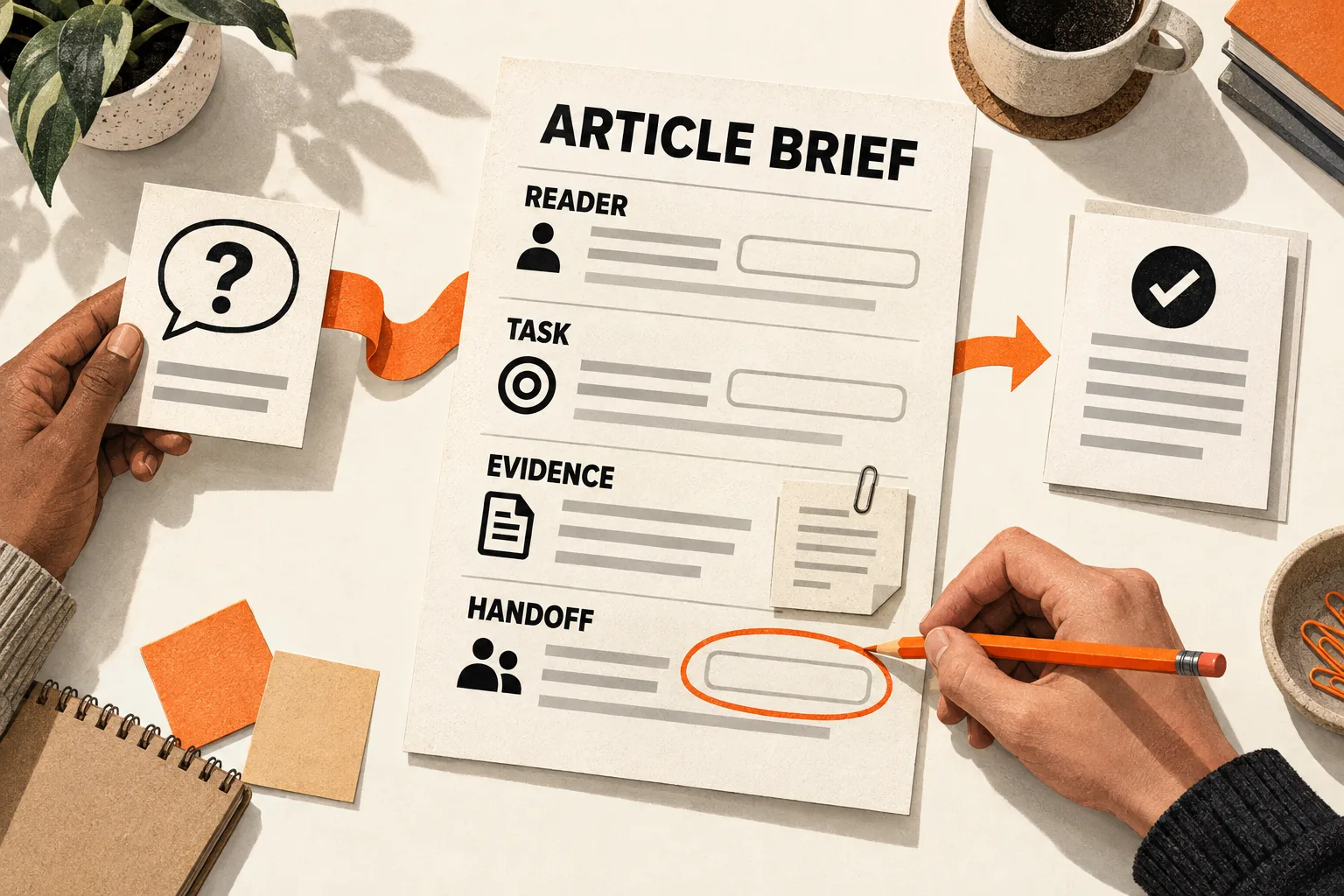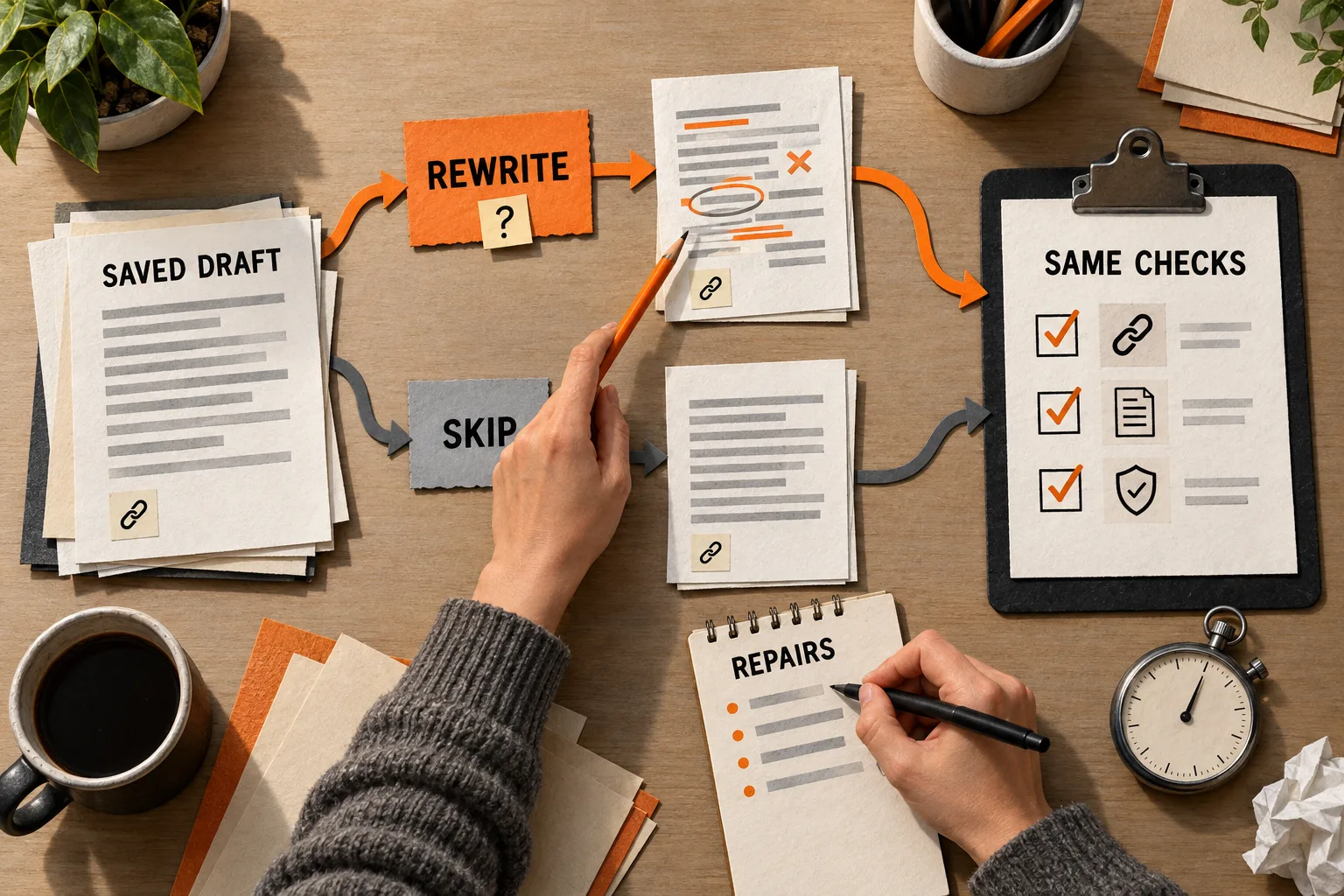
To review a multi-tool AI writing workflow, save what enters and leaves each stage, name the person who accepts it, and record what still needs fixing. Then compare one uncertain step with a version that leaves it out, using the same quality checks.
Start with one recent article. Map its research, drafting, editing, and visual handoffs before testing a change across several comparable pieces. You should finish with a specific decision: keep a step, combine it with another, repair its inputs, remove it, or test it again.
Map each handoff and its acceptance check
Choose a recurring format, such as a product tutorial or a founder’s weekly article. An unusual launch announcement that involved the whole team will be harder to use as a baseline.
Trace the article from its reader question to its final text and visuals. Include manual work: copying sources, restoring formatting, resolving conflicting edits, and waiting for approval. Record active work separately from elapsed time. A five-minute review can still hold up an article for two days.
Use this map as a starting point:
| Stage | Output passed forward | Person who accepts it | Acceptance check |
|---|---|---|---|
| Research | Brief and claim evidence | Writer | Important claims have supporting sources and recorded limits |
| Drafting | Draft with source links | Editor | The draft answers the reader’s question; gaps are marked and qualifications retained |
| Editing | Reviewed text and resolved issues | Content owner | Blocking issues are resolved and changed claims still match the evidence |
| Visuals | Inspected assets and text alternatives | Content owner | Labels match the text, the asset is readable, and its meaning is accessible |
Replace the role names with actual names. One person may hold several roles, but each handoff still needs an acceptance decision.
Write down the recurring defect each step should prevent. Examples include unsupported product claims, missing instructions, vague examples, or unreadable diagram labels. If two steps address the same defect, mark them for comparison.
Anthropic’s engineering guidance recommends starting with the simplest workable approach and adding complexity when it demonstrably improves outcomes. It also describes checks between successive model calls. Applying those principles to an editorial handoff is a workflow design choice; the guidance does not establish which tools will work best for your team. Read Anthropic’s workflow guidance.
Give research a checkable deliverable
Start with one reader question and the action the article should help someone take. If that scope is unclear, use FindVex’s SaaS content brief template. Comparing workflows is difficult when each version answers a different question.
For every consequential factual claim, retain:
- The proposed claim in plain language.
- The original source URL and supporting passage.
- The date checked, plus any relevant product version or plan.
- The limitation that must survive into the draft.
Keep verified facts, editorial recommendations, and hypothetical examples distinguishable. A public discussion can reveal a question worth answering; it does not establish how common the problem is or prove a product’s capabilities.
The writer accepts the research handoff after checking that the sources support the planned claims. Assign unresolved questions to someone or omit the affected claims. Resolve any missing evidence behind the article’s central promise before drafting.
Give drafting and editing separate responsibilities
Give the drafting tool the accepted brief, evidence, and a short voice guide. Ask for a complete answer to the reader’s question, with uncertainty preserved and gaps marked for review.
The editor first checks whether the draft enables the promised action. Can a reader follow the procedure? Does the example explain a difficult choice? Did a tentative benefit become a guaranteed result?
Give any AI editing step a bounded assignment, such as:
Identify unsupported factual claims, missing prerequisites, and contradictions. For each issue, quote the affected sentence and explain what needs checking. Preserve source links and qualifications. Suggest local changes before rewriting whole sections.
This produces issues a person can inspect. A request to make the draft “more engaging” leaves little basis for judging whether the extra pass helped.
Save the draft before editing and compare it with the edited version. Check changed numbers, feature names, quotations, and claims against the evidence. Agreement between models does not verify a source.
For voice problems, use the guide to building a brand voice from writing you own to give the editor concrete examples.
The content owner accepts the text when blocking issues are resolved, sources support the final wording, and the reader has a usable next step. Review the title and description too. Google’s guidance for generative AI content calls for accuracy, quality, and relevance, including metadata and image alternative text. See Google Search Central’s guidance.
Check visuals against the approved text
Begin the visual handoff with the passage the image should explain. Specify whether the asset is a real product capture, a diagram, or an illustration. Label a generated interface mockup so readers can distinguish it from an actual product screen.
Give the person creating the visual the approved labels and the relationship the reader needs to understand. Inspect the result at its intended display size. Check labels, arrows, numbers, and consistency with the article.
Assign someone to accept both the image and its text alternative. W3C’s decision tree bases alternative text on the image’s purpose and context. Informative images need their meaning conveyed; images that explain a link or button need the destination or action conveyed. Complex graphics need equivalent information elsewhere on the page. Purely decorative images use an empty alt attribute. Use W3C’s image decision tree.
Keep visual production optional when the article does not need an explanatory asset. If the publishing format requires a cover, measure its production effort separately from diagrams that help readers complete the task.
Compare one uncertain step with a simpler process
Choose a step whose value is uncertain, such as a second general rewrite. Save the same input and produce two versions: one with that step and one without it. Keep the brief, evidence, and acceptance criteria constant.
For an initial operational check, try three to five comparable pieces, including a difficult example. This is a suggested starting batch, not a statistically conclusive experiment.
Where practical, have the reviewer assess versions without tool labels. Record useful corrections, new defects, and blocking defects remaining before human repair. Then record human minutes through final acceptance, elapsed time, and incremental tool cost. Keep quality and effort separate: an acceptable final article may still have required substantial repair.
Set the decision rule before reviewing results. Keep an extra critique pass if it repeatedly catches consequential omissions and fits your review budget. Consider combining or removing a pass that mostly changes phrasing and adds repair work.
If a version fails an acceptance check, record the failure and the work needed to fix it. A faster draft that remains unusable has not met the comparison’s quality requirement.
Preserve necessary factual checks even if a small sample contains no errors. Removing a tool may mean transferring its useful check to a person or another stage. Also inspect the input before blaming the tool: a missing source in the handoff calls for repairing the handoff.
Worked example: a rewrite that adds repair time
Suppose a two-person SaaS team writes a tutorial explaining how to export a report. Its workflow uses a research assistant, a drafting model, a second model for a broad rewrite, and a diagram tool.
The team compares the saved draft with the rewritten version. All times and outcomes below are hypothetical:
| Active human work | With broad rewrite | Without it |
|---|---|---|
| Research and drafting | 55 minutes | 55 minutes |
| Rewrite setup and handling | 12 minutes | 0 minutes |
| Human review and repair | 30 minutes | 22 minutes |
| Visual preparation and review | 18 minutes | 18 minutes |
| Total | 115 minutes | 95 minutes |
In this example, the rewrite removes a limitation about which account role can export reports and changes an exact button label. Human review catches both errors. Both final articles pass the same acceptance checks, but the extra step adds 20 minutes of human work: 12 minutes handling the rewrite and eight additional minutes reviewing and repairing it.
The table compares active human effort only. The team would record elapsed time and tool cost separately.
A useful next test replaces the broad rewrite with a targeted critique for missing prerequisites and unclear instructions. The team keeps factual review and checks several more tutorials before changing its default workflow. The decision applies to that particular rewrite step and article format; it says nothing about traffic or the value of every second-model review.
Copy the handoff review worksheet
Complete one copy for each stage you evaluate:
- Article and reader task:
- Stage, tool, and model or version used:
- Saved input, brief, evidence, and instructions:
- Specific defect this stage should prevent:
- Saved output passed forward:
- Named person who accepts it:
- Acceptance check and reason to return it:
- Useful corrections made:
- New defects or missing context introduced:
- Blocking defects remaining before human repair:
- Active human minutes through acceptance:
- Elapsed time and incremental tool cost:
- Comparison version and decision rule:
- Result: keep, combine, repair, remove, or test again:
- Owner and next action:
Start with the handoff that needs repeated repairs
Choose one recent article and fill in the handoff map. Find the stage responsible for the most repeated repair work, name its acceptance owner, and write a check that would catch the problem.
On the next comparable article, save that stage’s input and output and record what the next person has to fix. Use the record to choose one change to test.