Your next marketing idea needs four hours a week. Your calendar is already full of a newsletter, social posts, a webinar, and reporting. Before adding the idea, decide which existing commitment should give up those hours.
A marketing stop, start, continue audit helps you allocate that time. Review each activity’s purpose, evidence, and future cost, then decide what to change. For an AI or SaaS founder with limited capacity, the result should be a revised calendar with an owner and review date for each decision. You can run the review alone or with the people doing the work.
Set the time budget and business priority
Choose one question for the review: How should we allocate our available marketing hours for the next planning period?
Write down the constraint. Perhaps the founder has six hours a week, a contractor has ten, and the spending budget cannot increase. Include preparation, revisions, replies, and reporting. A campaign that fits the cash budget can still consume more founder attention than you can afford.
Then choose a business priority, such as helping qualified prospects evaluate the product or helping new users complete a useful task. Define what counts as a qualified prospect or a completed task before reviewing results.
The University of Wisconsin-Madison’s Start-Stop-Continue exercise recommends defining the context, collecting individual observations, and assigning owners, timelines, and success measures to selected actions. For this marketing review, add a time budget to each decision.
Use a shared observation window where practical, but record each activity’s age. A new guide and a year-old newsletter have had different opportunities to produce evidence. You can review them on the same date while allowing different amounts of time to judge their outcomes.
Inventory activities at a size you can change
List tasks you could actually remove from the calendar. For example, “create three illustrated summaries of every article” gives you a clearer decision than “content.”
Separate activities when they have different audiences, purposes, or costs. A customer education webinar and a prospect webinar may use the same software while serving different needs.
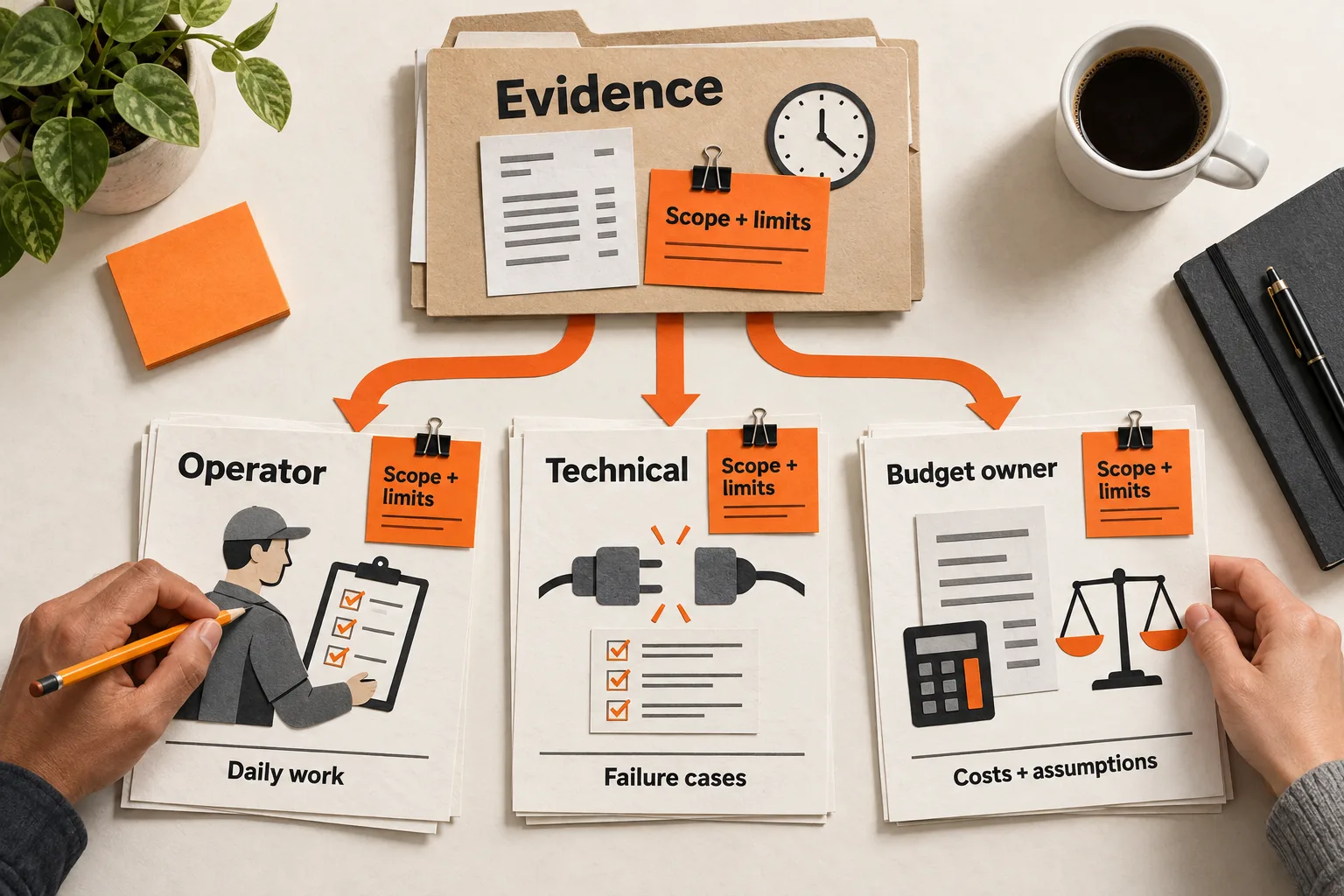
For each activity, record who it serves, what those people should do or understand next, and its owner, frequency, hours, and cash cost. Add dated evidence, unresolved questions, and the specific work that could use the same capacity. The worksheet below brings these fields together.
Count the full workflow. An AI-assisted article may take little time to generate but still require research, verification, editing, and distribution. Label estimates clearly if you have not tracked those hours.
Separate past spending from future obligations. Time already spent creating a webinar cannot be recovered. Future preparation time can be reassigned, but canceling may require notifying registrants or meeting a partner commitment. Account for that work before treating the hours as available.
Match the evidence to the activity’s purpose
Choose evidence that could reasonably support the intended outcome. For a prospect workshop, that might include attendance by suitable buyers, substantive questions, and agreed next steps. For onboarding content, it might include whether users complete the task the content explains.
Reach and engagement can help diagnose what happened. They do not, by themselves, establish whether an activity deserves more time. Keep the denominator visible: three useful conversations from eight suitable attendees means something different from three conversations from several hundred attendees.
Check attribution before comparing channels. Google Analytics assigns credit for important actions along a user’s path. Its paid and organic last-click model gives all credit to the last eligible channel, excluding direct visits unless the entire path is direct. Earlier interactions can therefore receive no credit under that model. Google’s attribution documentation explains these rules.
Before stopping an activity because it receives little reported credit, inspect the available paths and conversation notes for earlier contact. Use that context alongside the report when making your decision.
Keep customer language alongside the numbers. Joanna Wiebe’s review-mining method begins with the audience, its desired outcome, and the solutions people already use. Apply that discipline when choosing a new test: save the customer’s wording separately from your interpretation of the problem.
If your notes need structure, use FindVex’s pain-point evidence sheet. A few relevant observations can justify a small investigation; they do not establish how common a problem is across the market.
Define what stops, starts, and continues
Stop: End or pause a defined activity and release its future capacity. Candidates include duplicated work, activities with no current purpose, and repeated efforts whose evidence no longer justifies their cost. State exactly what stops and what remains available. You might end a live webinar series while keeping its useful recordings.
Start: Fund a bounded test. Specify the audience, hypothesis, time allowance, useful outcome, and review date. Name the activity that releases the capacity, or identify unused capacity. Replace “try video” with a commitment such as “spend four hours creating and testing one walkthrough for prospects concerned about setup.”
Continue: Protect a defined level of effort for a stated reason. Record the budget and conditions that would trigger reconsideration. A decision to keep a useful newsletter at its current frequency leaves any expansion for a separate review.
When evidence is incomplete, mark the activity “continue pending check.” Name the missing evidence, who will collect it, and when the decision returns. Give the temporary commitment a time limit.
Allow longer-term work a fair evaluation window and explain why it needs that time. You can check execution before judging the eventual business outcome. For example, a month may reveal that a campaign never reached its intended audience even when it is too early to judge its effect on purchases.
Worked hypothetical example: reclaim four hours a week
Imagine a two-person AI software company that helps support teams organize incoming requests. It has twelve marketing hours available each week. All figures and observations in this example are fictional and illustrate the review; they are not benchmarks.
Its current allocation is:
| Activity | Weekly hours |
|---|---|
| General AI news posts | 4 |
| Customer workflow newsletter | 3 |
| Prospect clinic | 3 |
| Reporting | 2 |
| Total | 12 |
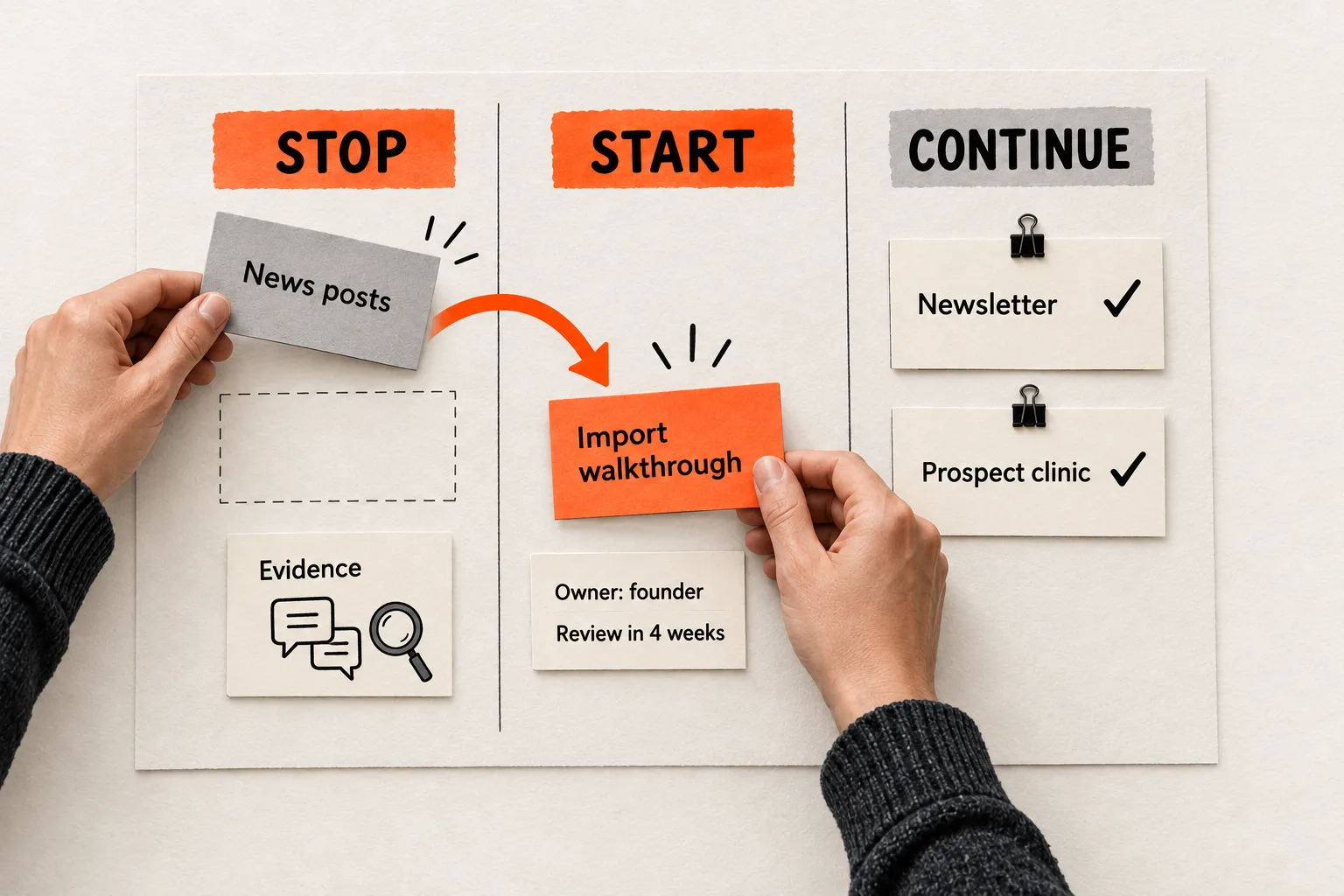
Over an eight-week observation window, the news posts attracted reactions, but the team found no conversations with suitable buyers in its reviewed records. The newsletter prompted five substantive replies about support workflows. The clinic led to three agreed evaluation calls. Some participants also read the newsletter, so the team keeps these counts separate rather than reporting eight unique prospects.
The team also notices a repeated question in its sales notes: how much work is required to import an existing backlog?
Stop: Pause general AI news production for four weeks, releasing four hours per week. Weak observed relevance and an immediate competing priority support a temporary pause. The team can reconsider that decision at the review.
Continue: Keep the workflow newsletter and clinic at their current effort levels. Record suitable participants, questions, and next steps. The small counts support continued observation, with no increase in hours. Reporting retains its two-hour weekly allocation.
Start: Use the released sixteen hours over four weeks for a backlog-import walkthrough: six hours to build it, six to use it in relevant prospect conversations, and four to review responses and revise it. Schedule that work within the four available hours each week.
The founder owns the test. Before starting, the team plans to show the walkthrough to six suitable prospects who have raised the import question. For each person, it will record whether the walkthrough answers the concern, what remains unclear, and whether they choose an evaluation next step.
At the four-week review, the team will use those notes to make a decision:
- If fewer than six suitable prospects saw it, investigate the distribution problem before judging the content. Any extension needs a new time budget and review date.
- If prospects still cannot explain the import steps or effort, revise the unclear section within a separately approved allowance.
- If the walkthrough answers the question, keep it available for relevant conversations and record any maintenance time. Evaluation next steps remain a separate outcome to track.
- If the notes show that import guidance does not address the concern blocking evaluation, stop developing this asset and investigate that concern.
Six prospects is a planning target for this fictional team. Their responses can guide the next small decision without establishing a conversion rate or proving that the walkthrough caused an evaluation. The weekly budget remains twelve hours.
Copy this decision worksheet
Complete one entry for every activity you review, including those you plan to continue. If a stop funds a start, link the two entries.
Activity and owner:
Audience and intended next step:
Observation period and activity start date:
Weekly hours, cash cost, and frequency:
Which costs are estimates:
Observed outcomes, denominator, and evidence links:
Missing evidence or competing explanations:
Decision: stop / start / continue / continue pending check
Reason for the decision:
Exact scope and effective date:
Capacity released or required, including transition work:
Alternative use of that capacity:
Related activity this decision funds or depends on:
Dependencies or commitments to resolve:
Next review date:
Evidence to collect and collection owner:
Decision rule: what would make us keep, revise, or stop this work?
Check that every start fits the available budget, every stop removes a real calendar commitment, and every continue has a reason and an owner. Include transition work in the first week’s plan so it does not consume hours already promised to the replacement.
Put one decision on the calendar
Choose one activity to change. Complete its worksheet entry, resolve any commitments, and update the recurring task. If you are replacing it, schedule the new work within the released hours and book its review.
At that review, compare actual effort and observed outcomes with the worksheet. Record what you will keep, revise, or stop, along with any question that still needs evidence.