Give your LinkedIn week one buyer question to work on. Publish a useful answer, reserve time for replies, and follow through on the next steps people agree to.
This routine gives an AI or SaaS founder without a sales team a 90-minute weekly budget. Treat it as a starting constraint, with room for one substantive post and a few relevant conversations. The schedule has no established lead rate. If replies need more time, reduce production or deliberately increase the budget.
Define whose interest would count
Before opening the feed, write down an audience and a problem you can help them examine. For example: support leaders at small B2B software companies deciding which tickets an AI assistant should escalate to a person.
For this routine, count someone as showing qualified interest when they fit that audience, describe a relevant problem, and agree to a useful next step. That might mean reviewing a worksheet, sharing their current process, or discussing a product evaluation. A reaction alone does not meet the definition. Agreement to receive a worksheet shows interest in that resource; buying intent still needs to be established.
Set aside a separate setup session to make your profile understandable to these readers. Explain what you are building, who it serves, and what someone can examine next. Describe the product’s current capabilities accurately. This setup time sits outside the recurring 90-minute budget.
Start with a short list of potential users, practitioners, and existing contacts whose discussions are relevant. If you cannot find your intended buyers discussing the problem on LinkedIn, investigate whether they use it for these conversations before expanding your publishing schedule.
Put the 90 minutes on your calendar
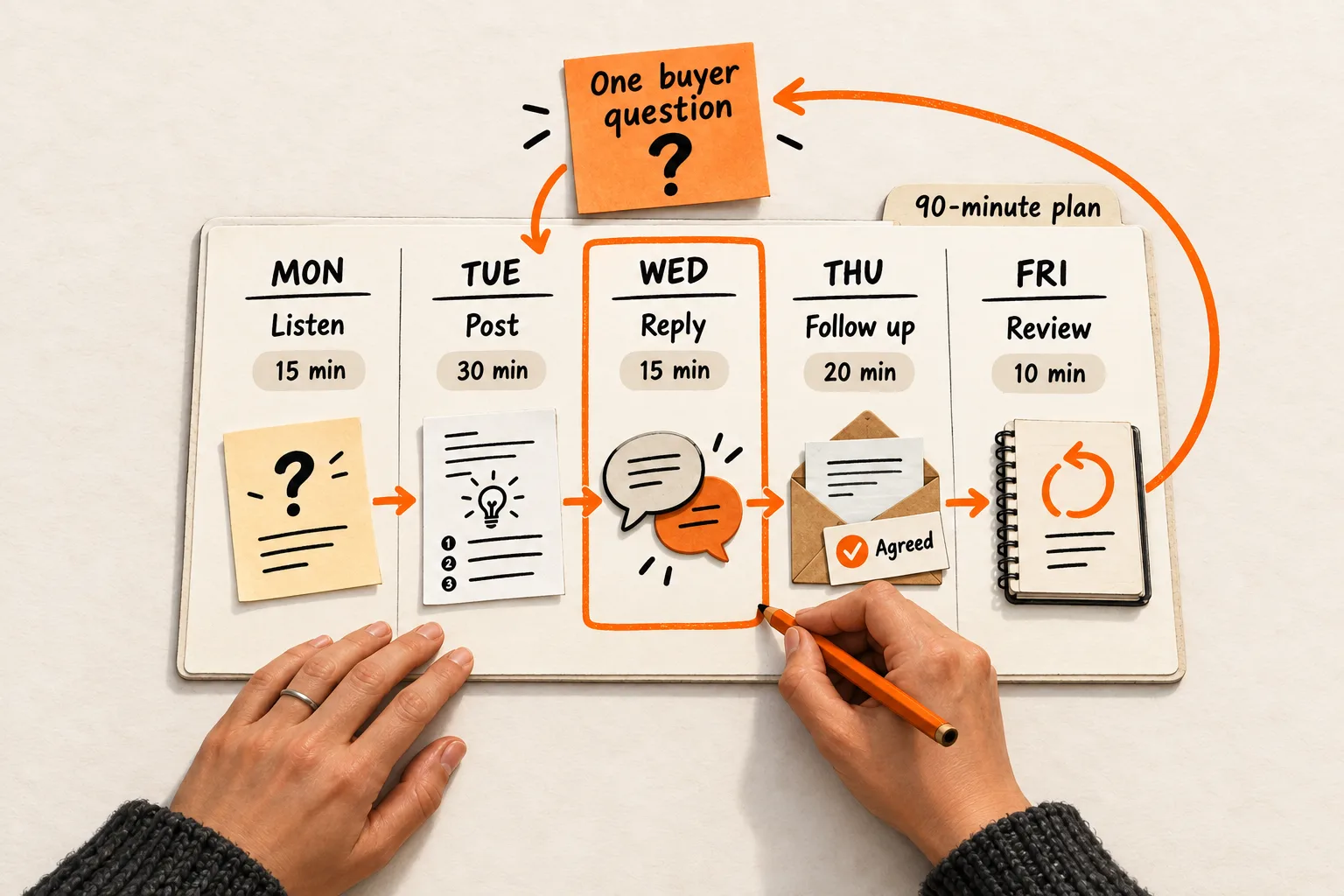
Use these blocks as spending limits. The times and quantities are planning choices, not platform benchmarks.
| Day | Time | Finish with |
|---|---|---|
| Monday | 15 minutes | One buyer question and supporting notes |
| Tuesday | 30 minutes | One useful post, checked and published |
| Wednesday | 15 minutes | Replies and relevant public contributions |
| Thursday | 20 minutes | Agreed follow-ups and updated notes |
| Friday | 10 minutes | A review and next week’s question |
Choose times you can keep. Move the blocks when customer work requires it, and handle outstanding replies before starting another post. Count reading, fact-checking, writing, and logging against the budget. If an example needs more preparation, carry it into the following week rather than squeezing unchecked work into Tuesday’s block.
With only 45 minutes, spend 10 listening, 15 writing a short answer, 15 handling conversations, and five reviewing. Skip the post when you lack a useful answer; use that time to read and respond to relevant discussions.
Monday: collect a question before drafting an opinion
Review recent customer questions, product objections, and public discussions from your chosen audience. Save a link or private note alongside the wording that caught your attention. Keep the person’s actual words separate from your interpretation.
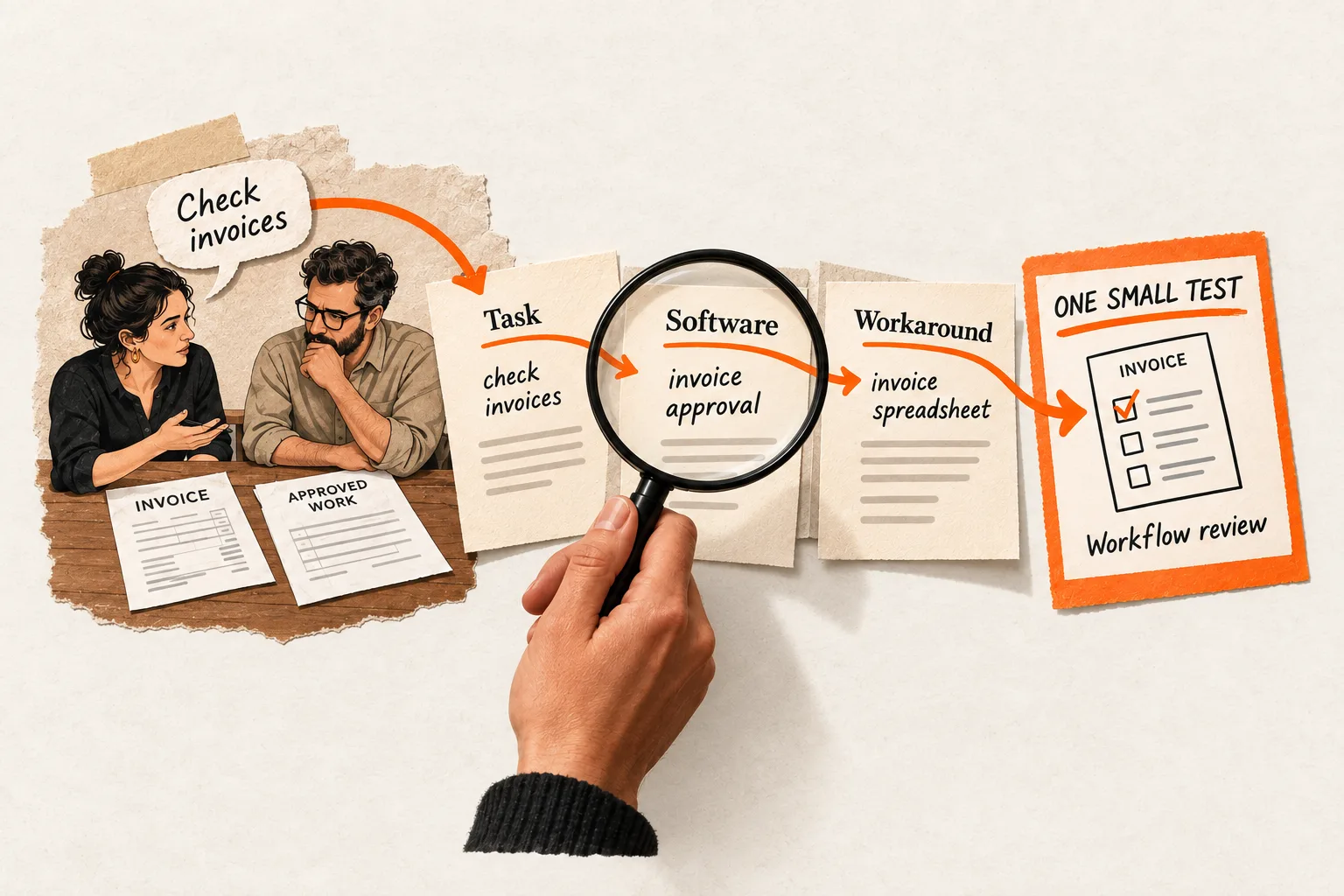
A usable note identifies the situation, obstacle, and decision. “People care about AI reliability” leaves you with a broad theme. “A support manager needs to decide when an uncertain answer should trigger a human handoff” gives you a question to address.
Choose something you can answer with a procedure, worked example, or explanation of a product tradeoff. If your notes are scattered, use the pain-point evidence sheet to organize them. Public discussions suggest questions to investigate; they do not establish how common a problem is across your market.
Tuesday: publish an answer someone can use
Build the post around one decision. Describe the situation, explain a useful action, show an example, and state its limitation. Give the reader enough to try the action without contacting you.
For an AI product, distinguish demonstrated capabilities from work you are still testing. Label synthetic examples. If you describe customer work, obtain permission where needed and remove identifying details.
LinkedIn says it is reducing repetitive, low-substance posts and engagement bait. Its announcement does not establish an ideal post length or guarantee distribution. LinkedIn’s feed update
Use a closing question when the answer would help you understand the problem. Asking how readers handle a particular exception gives them something specific to discuss. A generic request for agreement adds little to the answer you just published.
Wednesday: contribute to relevant discussions
Answer substantive replies to your post first. Then revisit discussions from Monday’s notes. Add a diagnostic question, an example with limits, or a missing step that would help someone work through the problem.
There is no comment quota in this routine. When you have nothing useful to add, read and save any question worth exploring next week.
Read and post comments yourself. LinkedIn prohibits engagement pods and automated comments, including comments posted by scripts or third-party tools without a person taking the posting action. It describes possible visibility limits and account restrictions for these activities. LinkedIn’s explanation of authentic engagement
Thursday: deliver the agreed next step
Treat a comment, connection acceptance, or profile visit as context for a conversation. Ask before moving that conversation into private messages or sending a sales follow-up.
If someone describes a problem your worksheet addresses, offer it. Where appropriate, share the public resource in the discussion so other readers can use it too. Move to a private message when the person requests it or agrees to continue there.
Deliver what you offered. A promised checklist should arrive as a checklist. Ask about a call when the conversation gives both people a reason to have one.
Record the agreement, who owns the next action, and any date the person requested. If they stop responding, use the context to decide whether one reminder would help, then stop pressing. This is a suggested conversation practice, not a tested follow-up cadence.
Worked example: an AI support founder’s week
The following scenario is hypothetical. It illustrates the workflow and counting rules; it reports no customer results.
On Monday, suppose a founder building an assistant for small SaaS support teams finds a question about confident answers based on outdated documentation. The founder chooses one topic: testing what happens when source material conflicts.
Tuesday’s post could use this synthetic exercise:
Create a test ticket asking which policy applies when two help articles give conflicting instructions. Record the expected behavior before running the test. In this example, the expected behavior is a handoff to a person. Then record whether the assistant answered, asked for clarification, or escalated, along with the sources it used. Passing this case would not establish reliability across other tickets.
On Wednesday, imagine a support manager at a small SaaS company replies that their team encounters this problem. The founder asks which source takes precedence in their workflow. After discussing it, the manager agrees to receive the test sheet privately.
Thursday’s sample message:
Here’s the test sheet you asked for. The conflicting-source example is filled in; the remaining rows are blank for your team’s cases. If you try it, I’d be interested to hear which expected behavior was hardest to define.
Friday’s entry would look like this:
| Field | Entry for this hypothetical exchange |
|---|---|
| Audience fit | Support manager at a small SaaS company |
| Relevant problem | Conflicting source material |
| Agreed next step | Send the test sheet privately |
| Delivery status | Sheet sent |
| Qualified interest | One person under this routine’s definition |
| Commercial outcome | No meeting, evaluation, or sale established |
| Question to explore next | How the team decides which source takes precedence |
The same person may reply several times or react to several posts. They still count once in the weekly qualified-interest total. Their resource request remains separate from any later commercial outcome.
Friday: review conversations alongside analytics
Open the post’s analytics through its impressions count or View analytics control. LinkedIn’s reporting includes discovery, social engagement, and viewer demographics, with available categories depending on the post type. Your own views and interactions also count. LinkedIn’s post analytics guide
Use those numbers as context for a small conversation log. Record time spent, relevant people engaged, qualified interest, and agreed next steps. Keep one row per person for the week, updating it as the conversation develops. Mark whether the person is a new contact or someone you already knew so continued conversations do not look like newly generated interest.
Keep attribution as unknown when you cannot establish it. Someone may have read several posts or known you before replying. The log cannot isolate the effect of one post.
Review a few weeks together before changing the routine. If peers respond but intended buyers do not, reconsider the audience and examples. If buyers discuss the problem but decline the next step, examine whether that step helps them. When useful conversations take more time, reduce posting to make room for them.
A short trial can help you judge the workload and identify questions worth pursuing. It cannot establish a dependable lead rate.
Copy the worksheet and schedule next week
Use this planning sheet before Monday’s block:
Week:
Audience and current problem:
Evidence or discussion link:
Audience's wording:
My interpretation:
Question the post will answer:
Example, supporting facts, and limitations:
Weekly time limit and calendar blocks:
Relevant discussions to revisit:
Resource or next step to offer:
Qualified-interest definition:
For each relevant conversation, keep a brief entry:
Person and discussion link:
New or existing contact:
Audience fit and relevant problem:
Next step agreed, including permission to message:
Action owner and requested date:
Delivery status:
Qualified interest this week: yes / no / unclear
Meeting, evaluation, or sale, if separately established:
Attribution: known source / unknown
At Friday’s review, add actual minutes spent, the number of unique people meeting your qualified-interest definition, outstanding actions, and one change or question for next week. Leave uncertain entries marked unclear rather than filling gaps with assumptions.
Start by writing one buyer question in the sheet and booking the five calendar blocks. Reserve the reply time before you begin drafting the post.