Before saving a Reddit post as customer evidence, check whether it describes a relevant firsthand experience, whether you can inspect its context, and whether the author has a commercial connection. Record those judgments separately. A useful account can come from an affiliated author, and a product recommendation can leave affiliation unknown.
For a small AI or SaaS team, the task is to build a sample you can explain: what you included, what you set aside, and which question deserves closer research. The worksheet below gives you a place to make those decisions.
Define the decision and collection boundary
Write one research question that names a user and a task. For example: What makes it difficult for small agency teams to transfer meeting decisions into their project tools?
That question helps you set aside an unrelated complaint about transcription accuracy while keeping a detailed account of missing task owners. It also leaves room for evidence that the workflow already works well.
Set a collection boundary before reading. One possible starting point is 20 candidate posts or comments, across two relevant communities, from the past 90 days. These are workload limits, not a validated sample size. Specify how many candidates you will inspect from each search and how you will select replies so one busy thread does not consume the sample.
Record the communities, queries, date window, result sort order, sequence of searches, and stopping rule. If you change the scope, label the additional collection separately. This makes it easier to notice when you are extending a search mainly to find support for your product idea.
English-language posts do not establish that an author is in the United States. If geography matters, record only what the author explicitly discloses and leave the rest unknown.
Search for the workflow and read the surrounding conversation
Try phrases that describe the activity: meeting follow-up, assigning action items, or copying notes into a project tool. People may describe their work without naming your product category.
Reddit supports filters such as subreddit: and title:, plus uppercase AND, OR, and NOT. It also supports searching comments within a post. Try subreddit:projectmanagement "action items" as a starting query, then adapt the community and wording to your question. This query illustrates the syntax; it does not establish that useful accounts will appear. Reddit’s search documentation explains the controls.
Inspect a small batch before adding exclusions. Removing every result containing launch or tool could hide a useful account. Narrow the query when you can name the recurring material you want to remove.
Open the original thread before accepting a candidate. Read the parent post and surrounding replies. A recommendation may be a vendor’s reply; a complaint may describe a problem the author later resolved. Record any context that changes its meaning.
Assign each observation a disposition
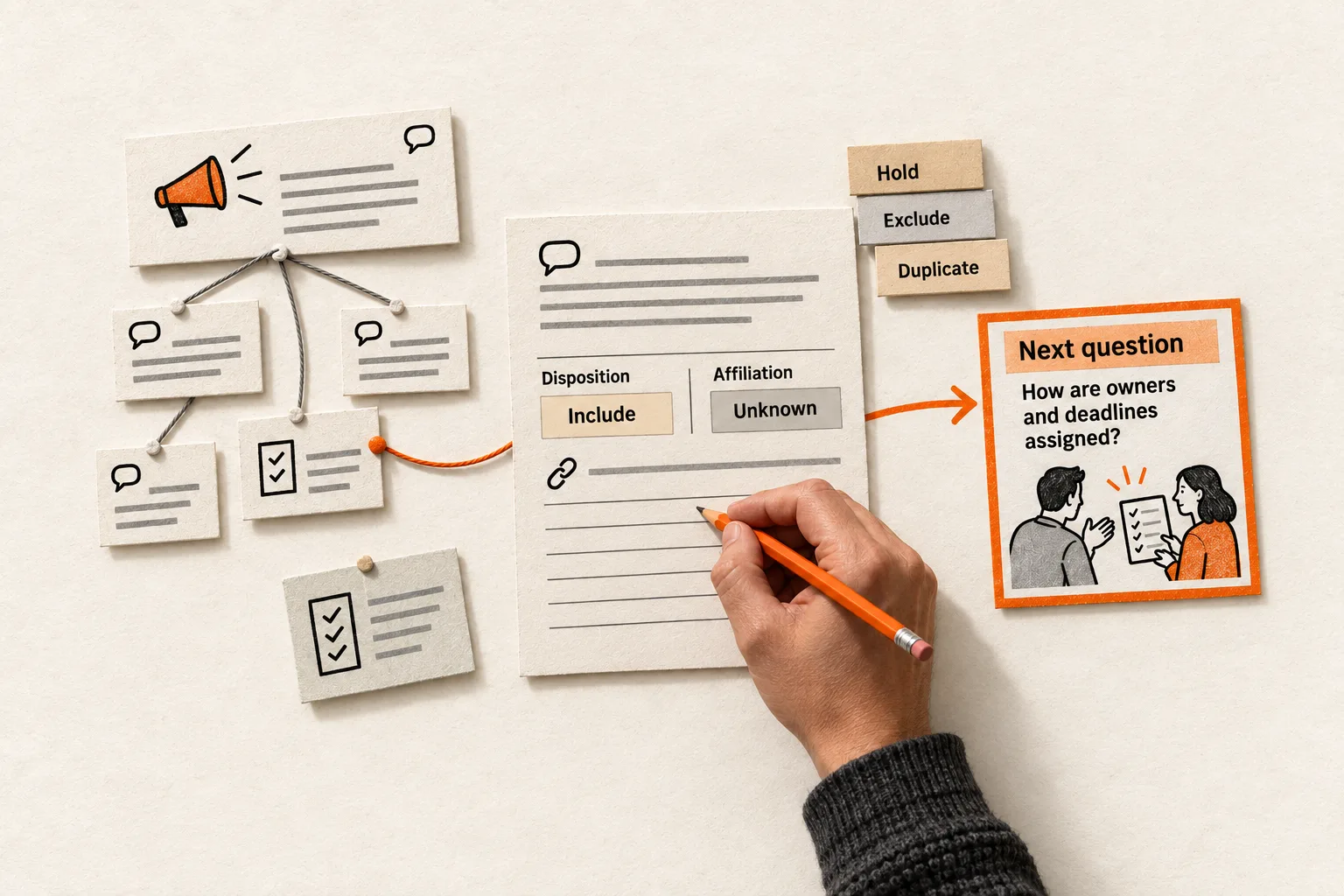
Use four labels: include, hold, exclude, and duplicate. Apply them to individual observations. A promotional thread can contain a useful reader comment, and a useful thread can contain irrelevant replies.
Include an observation when it describes the target task or a relevant adjacent step, gives a firsthand account with enough context to understand what happened, and identifies an obstacle, workaround, consequence, or successful approach. You must also be able to inspect the source in context.
Put material on hold when the author’s relevant role is unclear, the account is secondhand, or the original is inaccessible. A request for recommendations can suggest a research question without establishing an experienced problem.
Exclude material that falls outside the task, contains only a generic opinion, or promotes a product without usable workflow detail. Give each exclusion a short reason. Tone alone should not decide eligibility: an angry post can still describe a specific incident.
Mark repeated versions of the same account as duplicates and link them to the retained record. If one author describes distinct incidents, keep the observations separate but retain their shared author code.
Keep relevant counterexamples. A team that solved the handoff with a checklist may help you understand when another tool is unnecessary.
Record commercial connections without guessing motives
Reddit says promotional content is not inherently spam, and communities set different rules for it. Permission to post therefore does not establish that an account is independent customer evidence. Reddit’s moderation guidance explains the distinction.
Look for observable connections: a disclosed founder role, an affiliate link, an invitation to book a demo, or repeated promotion of the same product. Record what you found without guessing at the author’s motives.
Treat affiliation as a separate field from disposition. An included observation may be affiliated if it contains useful firsthand detail. Keep it separate when summarizing customer accounts, and do not count it as independent buyer confirmation.
Use unknown when you cannot assess affiliation. Use none observed when you checked the available context and found no connection; that label still does not verify independence. A product link alone does not prove that a satisfied user is advertising. If an unresolved connection could change how you interpret the account, put it on hold and record the question.
Count observations, author accounts, and threads separately. Several observations from one account can explain a problem in detail without showing that several people experienced it. Different usernames do not prove different people, and agreement in one discussion does not by itself establish independent recurrence.
Copy the collection and observation worksheet
Keep the source account separate from your interpretation. GOV.UK’s research analysis guidance recommends recording what was seen or heard before developing findings and actions. The worksheet adapts that distinction to public discussions. Read the research analysis guidance.
Complete this collection header once, then duplicate the observation block for each candidate. These fields are an editorial method you can adapt.
COLLECTION
Research question:
Target role and task:
Communities:
Queries, in the order used:
Posting-date window / collection date:
Result sort order and reply-selection rule:
Candidate limit per search / stopping rule:
Scope changes, if any:

OBSERVATION
Record ID:
Disposition: include / hold / exclude / duplicate
Reason for disposition:
Direct post or comment URL:
Community / posting date / date checked:
Discovery query and position in collection:
Author code / explicitly stated role:
Geography, if relevant and disclosed:
Short excerpt or labeled paraphrase:
Parent-thread context that changes the meaning:
Task / obstacle / workaround / consequence:
Affiliation: disclosed / suggested / unknown / none observed
Specific evidence for affiliation label:
Related author, thread, or duplicate record IDs:
Your interpretation:
Unresolved questions or contradictory evidence:
Next check or research question:
Use not stated for missing details. For excluded entries, retain enough information to revisit the decision: the source, disposition, and reason. Keep fuller records for included and held observations.
Use author codes in summaries and retain only the identity detail needed to trace or deduplicate observations. Recheck sources before relying on them in public writing. If an original is unavailable, mark it as unverifiable.
FindVex’s guide to building a pain-point evidence sheet from public discussions explains how to develop the observations that survive this filter into a research question.
Worked hypothetical: meeting follow-up complaints
Imagine a founder considering an AI assistant for agency meeting follow-up. All counts and observations in this example are fictional.
The founder reviews 20 candidate entries under a fixed collection rule:
| Disposition | Entries | Reason |
|---|---|---|
| Include | 8 | Relevant firsthand accounts with usable context |
| Exclude | 5 | Promotional claims without usable workflow detail |
| Exclude | 3 | Unrelated tasks |
| Hold | 2 | Insufficient context |
| Duplicate | 2 | Repeated accounts already recorded |
The eight included observations come from six author accounts across five threads. Those counts describe the collection, not six verified customers or five independent confirmations.
Three included observations illustrate how to preserve differences:
| Record | Fictional observation | Question it suggests |
|---|---|---|
| H-01 | An author manually enters task owners after each meeting. | Is this step burdensome, or an acceptable part of assigning responsibility? |
| H-02 | Another author reports that a shared checklist works well. | What makes the checklist sufficient for this team? |
| H-03 | A third author describes summaries that omit deadlines. | Where are deadlines captured and checked? |
One excluded vendor post promises to eliminate follow-up work. A reply beneath it describes a specific handoff failure. The founder evaluates the reply separately. If it meets the inclusion rules, it can remain in the sample with affiliation marked unknown; it cannot be presented as verified independent buyer evidence.
A finding supported by the three illustrated records would be: H-01 describes manual owner entry, H-03 reports omitted deadlines, and H-02 describes a workable checklist. These accounts suggest examining how teams assign responsibility and preserve deadlines after meetings.
Manual entry alone does not establish frustration. The example also leaves problem frequency, purchasing authority, and willingness to pay unanswered.
The next task is to examine a recent meeting-to-task handoff with willing target users. Ask them to show how owners and deadlines get assigned, where corrections happen, and whether the current process is acceptable.
Audit the filter before using the findings
Strict inclusion rules can exclude brief but useful accounts. Loose rules leave more ambiguity to resolve. The hold category preserves leads while keeping them separate from accounts with enough context to interpret.
Review a few excluded entries and every borderline entry before summarizing. If possible, have a teammate apply the rules independently. When you disagree, identify the ambiguous rule and recheck affected records. A solo founder can do a second pass with the earlier dispositions hidden.
Check that someone else could locate each source and understand its disposition. Separate repeated accounts and affiliated claims, keep successful workflows beside the problems they challenge, and distinguish reported experience from your interpretation. Name the collection boundaries and unresolved questions in the summary.
Finish with one question for direct research
Choose one research question, set a collection boundary, and process the candidates with the worksheet. Then write a short decision note:
Finding and supporting record IDs:
Counterexample, or none found within this collection:
What remains unknown:
Next research question:
Owner and next action:
A small Reddit sample can help you choose what to investigate next. It cannot establish market prevalence or willingness to pay. Finish with a question you can test by examining a target user’s actual workflow.