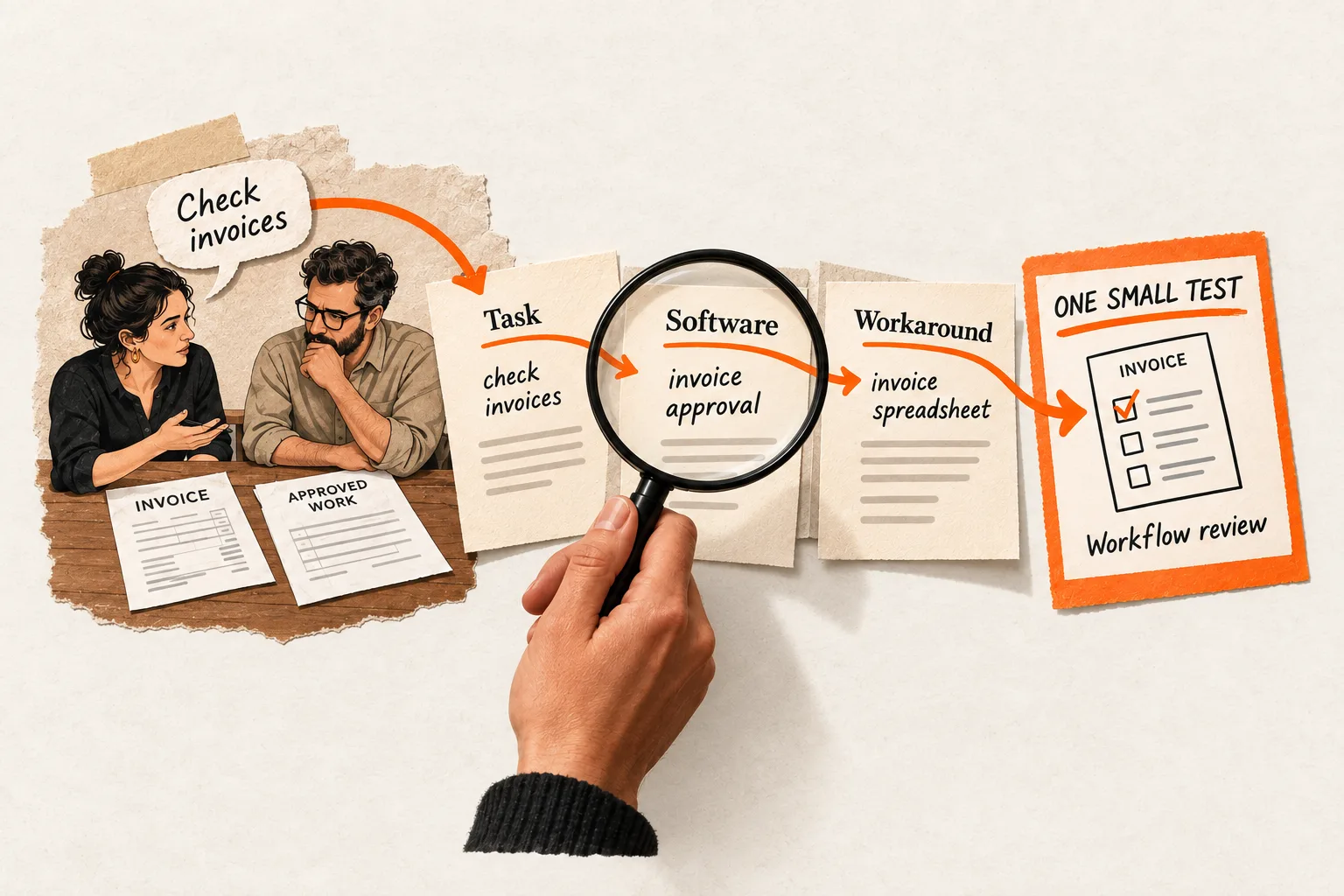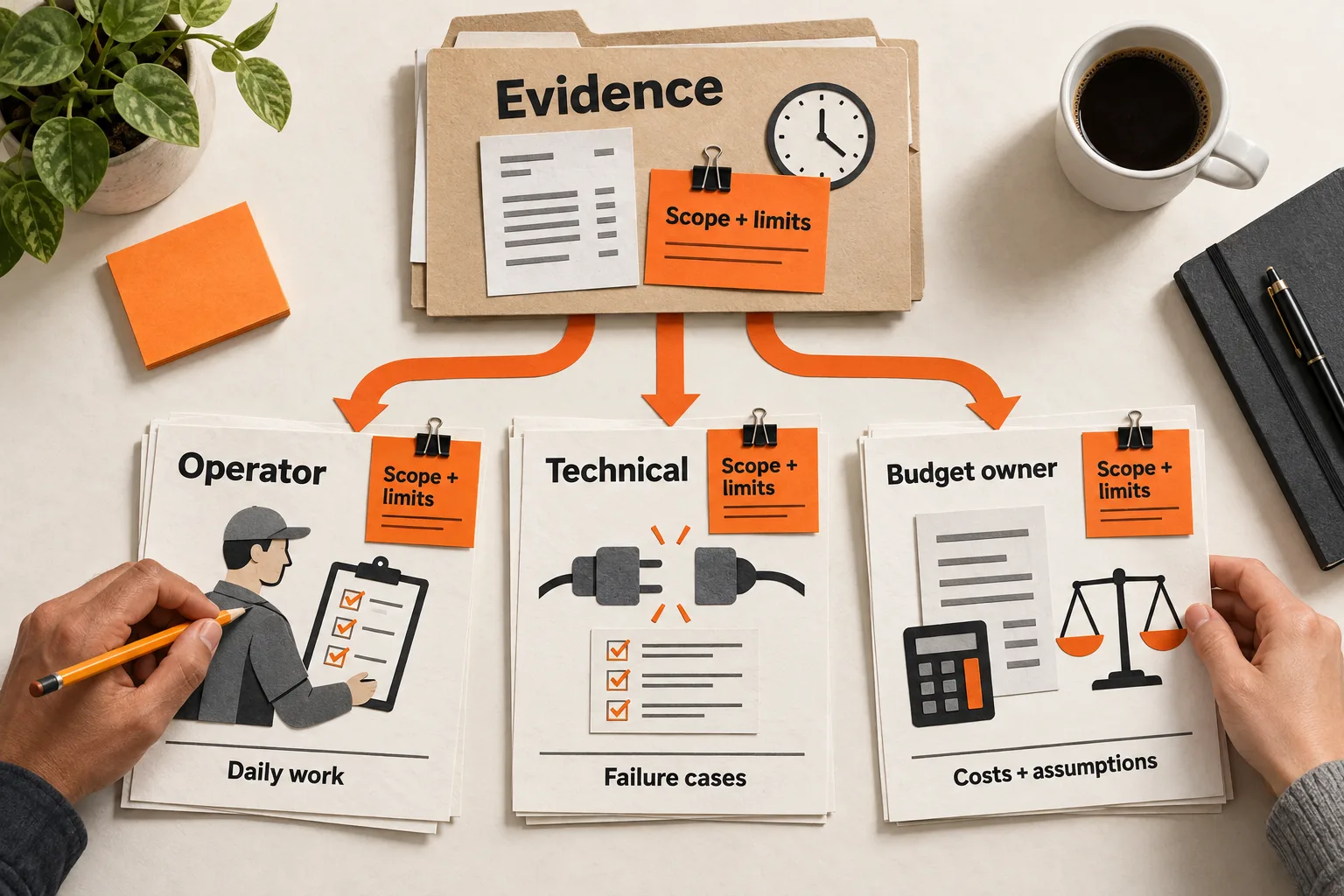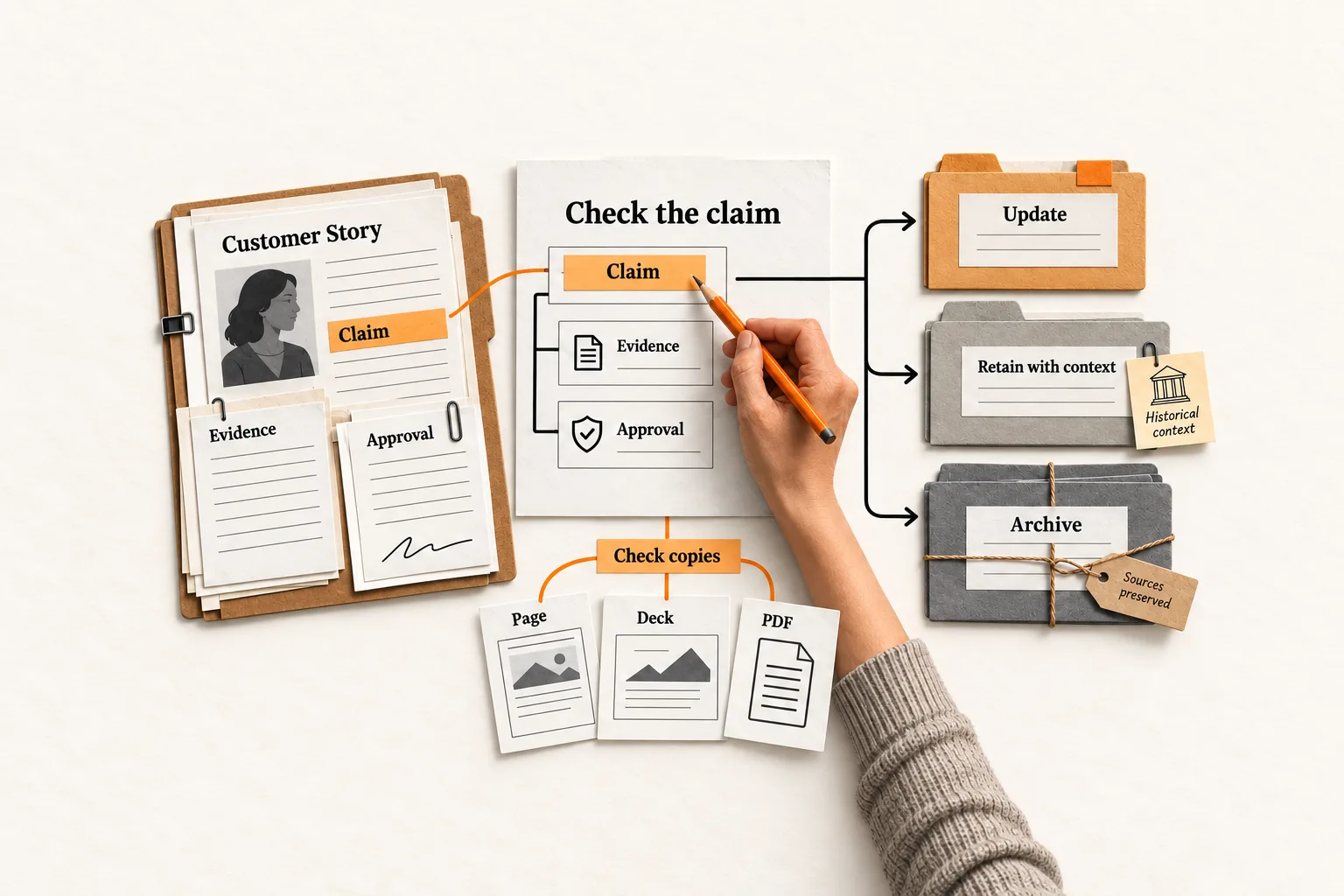
A case study content audit gives each existing customer story a documented decision: update it, retain it with historical context, or archive it. Start with the stories your team shares most often, then check the evidence and approval behind their strongest claims.
Consider a story with a useful result, screenshots of a retired feature, and a headline number whose supporting spreadsheet is missing. Before sending it to another prospect, you need to establish what it still supports and which parts are suitable for reuse.
The worksheet below connects that decision to the original evidence, the public page, and the copies circulating in decks and downloads.
Inventory each story and the places its claims appear
Give each customer story one record. Link its web page, PDF, interview recording, approval correspondence, and supporting measurements. Then list where someone reused its claims: a homepage quote, presentation slide, email attachment, or social graphic. Correcting the article can leave those copies untouched.
Record the original publication date separately from the period when the customer achieved the result. Add the last factual review date and product version, if known. An article published in 2024 might describe a pilot completed in 2023; neither date tells you whether someone has checked it since.
For a small library, use one spreadsheet row per story and a linked document for detailed evidence. Assign an owner, even if the founder handles every review.
Prioritize frequently shared stories, prominent claims, and stories affected by major product changes. Keep the buyer question in view: a page with little traffic may still answer a specific implementation question that comes up in sales conversations.
Trace claims to their original support
Read each story sentence by sentence. Separate the customer’s statements, measured results, and your team’s interpretation.
For a numerical claim, locate the underlying calculation or customer confirmation. Record the baseline, comparison period, sample, exclusions, and measurement owner. Describe a customer’s estimate as an estimate. If the only source is a remembered number in an old presentation, mark it unresolved until you can trace it.
For AI products, record what produced the result: the model or product version, document set, workflow, and human review. A result achieved with manual corrections does not establish unattended performance.
Check qualitative claims too. Praise for setup support does not establish endorsement of every feature. Keep quotations faithful to their original meaning; don’t rewrite an old quote to mention a new product name or capability.
Use three evidence states:
- Verified: the supporting material is available and supports the wording.
- Qualified: the evidence supports a narrower statement that needs explicit context.
- Unresolved: the source is missing, contradictory, or awaiting confirmation.
Pause reuse of an unresolved claim. Other parts of the story may remain useful if you can support them independently.
Check permission and the impression the story creates
Find the approval record and identify what it covers: customer name, logo, exact quotation, metrics, publication channels, and any stated limits. A factual correction and permission to distribute the revised asset are separate checks.
A departed customer contact is a reason to review the record. Their departure alone does not establish whether an existing approval remains usable. For changed wording or a new use, identify the appropriate current approver and resolve gaps before distribution.
Read the page as a prospect would. Does it imply that the customer still uses the product? Does a screenshot suggest that a retired feature remains available?
The FTC’s guidance says older endorsement claims must remain accurate. If an endorsement implies current use, the advertiser needs good reason to believe that use continues. The FTC also recommends obtaining new endorsements when the product has changed. FTC endorsement guidance
Check what the result implies about other customers, too. The FTC explains that specific results in endorsements usually suggest that others can expect similar performance. Advertisers need adequate support for typicality or a clear disclosure of generally expected performance in the circumstances shown. A statement such as “results may vary” does not resolve that implication. Review the headline and promotional excerpts alongside the full story; a historical date or pilot label alone is not enough. FTC guidance on customer results
Decide whether to update, retain with context, or archive
Update a story when it still answers a current buyer question and you can verify the changes. Correct the product explanation, replace obsolete instructions, and add newly approved evidence where available. Keep old measurements tied to their original period. Label a current screenshot as a current illustration if it did not document the original result.
Retain with context when the historical experience remains useful and continued publication is appropriate. Put the limits near the relevant claim. Readers should learn that a story describes a retired workflow before trying to reproduce it. Permission, accuracy, and the impression of expected results still need review.
Archive when you cannot support the central claim, resolve permission concerns, or explain the story without misleading readers. Specify whether you mean a public historical page or an internal record. A public archive still distributes the content; an internal archive removes it from public use. Keep only records you are entitled to retain, with appropriate access restrictions, and document why the story changed.
For updated pages, preserve the original publication date and label a substantive update separately. Google recommends prominent, clearly labeled publication or update dates and corresponding datePublished or dateModified structured data. Equivalent visible and structured dates should match. These dates describe the page; the customer’s measurement period belongs in the account of the result. Google’s byline date guidance
Worked example: audit a retired AI workflow
Suppose a small AI SaaS company has a 2023 customer story titled “Cut document review time by 40%.” The product now uses a different model, and the original customer contact has left. All records, permissions, and decisions in this example are hypothetical.
The team finds timing records for 20 documents in a four-week pilot. Average review time fell from 50 to 30 minutes per document: (50 - 30) / 50 × 100 = 40%. Human reviewers checked every output. The records support that calculation for the measured sample, but they do not establish performance beyond the pilot or isolate the model’s contribution from the rest of the workflow.
The evidence record can therefore say: “Average review time fell from 50 to 30 minutes per document in the measured pilot, with human review throughout.” This is a description of the recorded measurement, not ready-to-use promotional copy.
The team finds approval for the original web story and PDF, but nothing covering a new paid campaign. A current customer approver confirms permission to keep the pilot account public. That resolves the permission question; it does not supply evidence about current performance or generally expected results.
Because those questions remain unresolved, the team chooses an internal archive for the numerical story and pauses campaign reuse. It removes the homepage excerpt, retires the public PDF, and records the page’s removal treatment. The timing records, original approval, and decision remain linked internally where retention is permitted.
The description of how reviewers handled difficult documents may still support a useful historical workflow article. The team can review that narrower account separately for accuracy, approval, and misleading implications before making it public. It does not carry the old percentage into a new headline merely because the calculation is correct.
Repair the paths people use to find and share stories
For each story that remains available, add a short internal description of the buyer problem, relevant workflow, evidence, and reuse restrictions. Organize the library around questions such as implementation effort or human review requirements.
Keep the existing URL when the same story remains there. If you move it or consolidate it into a relevant replacement, map the old URL to the replacement and update internal links. Google recommends permanent server-side redirects for moved URLs and appropriate 404 or 410 responses for content removed without a replacement. Google’s URL migration guidance
Check downloads, presentation templates, and excerpts as well as the web page. You may not be able to recall attachments already sent, but you can stop distributing outdated copies and provide a stable link for future use.
Once a story clears the audit, use FindVex’s guide to building a reuse map for one approved customer story to connect its approved claims to the assets that use them.
Copy this audit worksheet
Complete one record before expanding the audit to the whole library.
| Field | Record |
|---|---|
| Story and owner | Title, main URL, asset locations, responsible person |
| Reader need | Buyer question the story answers |
| Dates | Original publication, result measurement period, last factual review |
| Original conditions | Product version, workflow, sample, human involvement |
| Central claim | Exact wording, evidence location, measurement owner |
| Evidence assessment | Verified, qualified, or unresolved; baseline, calculation, exclusions, limits |
| Permission | Approval record, covered assets and uses, restrictions, open questions |
| Present-day meaning | Current use confirmed or unknown; historical context; support for implied expected results |
| Decision | Update, retain with context, or archive; reason and public or internal status |
| Corrections | Exact page, excerpt, deck, or download to change; owner and due date |
| Distribution checks | URL treatment, internal links, approved version location |
| Completion | Decision owner, completion date, next review trigger |
Before closing the record, trace the main claim to its support and check every listed correction. Ask a teammate to find the approved version and explain where it can be used. If you work alone, follow the same path from the library entry through the linked files.
Set review triggers for changes that could invalidate the story: a retired feature, new model, customer correction, permission change, or reuse in a new channel. Track unresolved claims and outdated copies alongside library usage. More shares may indicate that a story is easier to find; they do not establish that it caused additional sales.
Start with the story you shared most recently
Locate its approval and the evidence behind its strongest claim. Complete one worksheet, choose update, retain with context, or archive, and assign the resulting corrections. Leave the record open until you have checked the page and its listed copies.