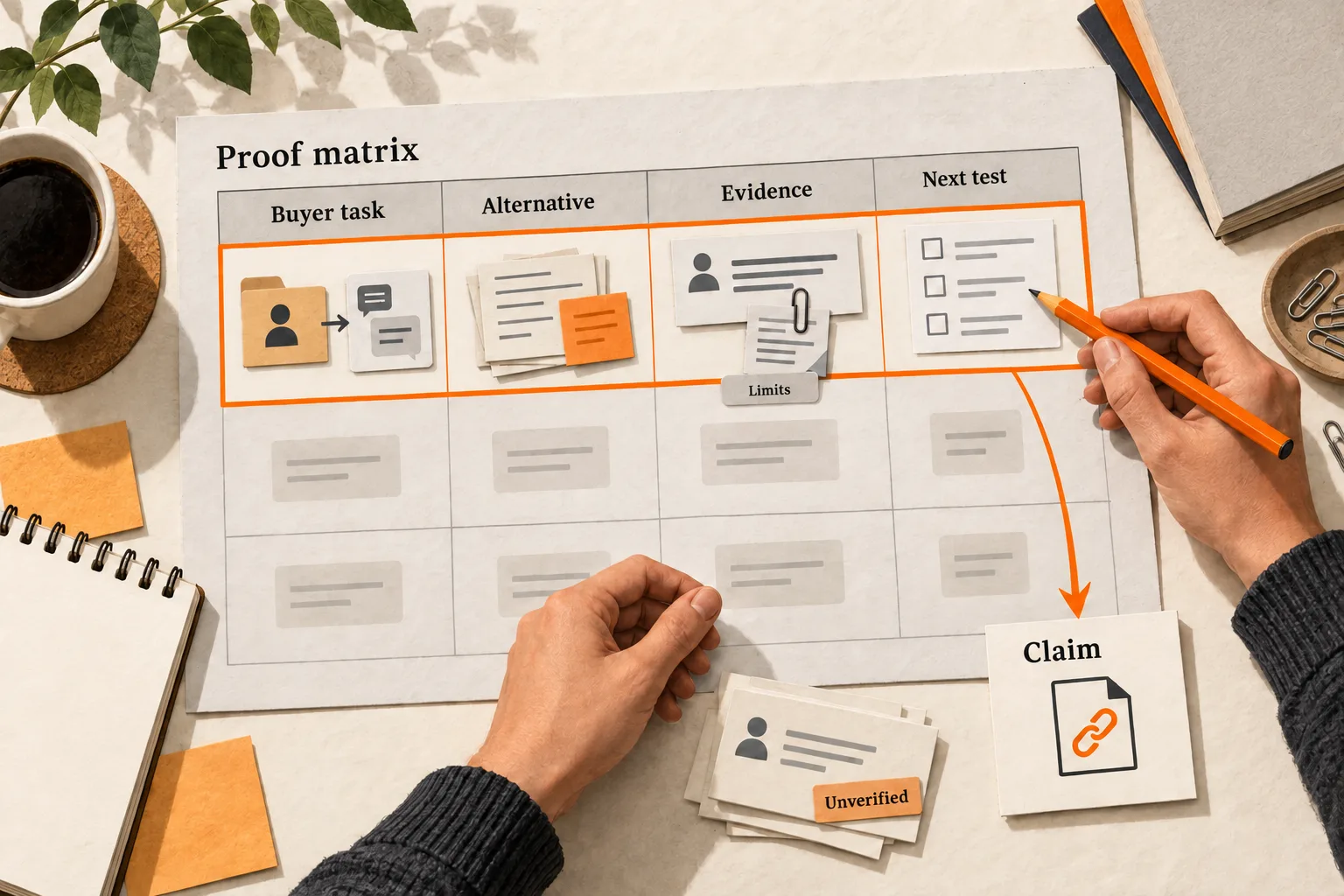
To explain why a buyer should choose your AI SaaS, connect each proposed advantage to a task they need to complete and evidence they can inspect. A proof matrix gives you a place to record that connection before rewriting your homepage.
Start with workflow fit, integration depth, and reliability. For each, describe the buyer’s current alternative, what your product does, and what you have verified. The finished matrix should help you choose a defensible claim and identify the product work or testing needed to support the next one.
Start with the buyer’s actual alternative
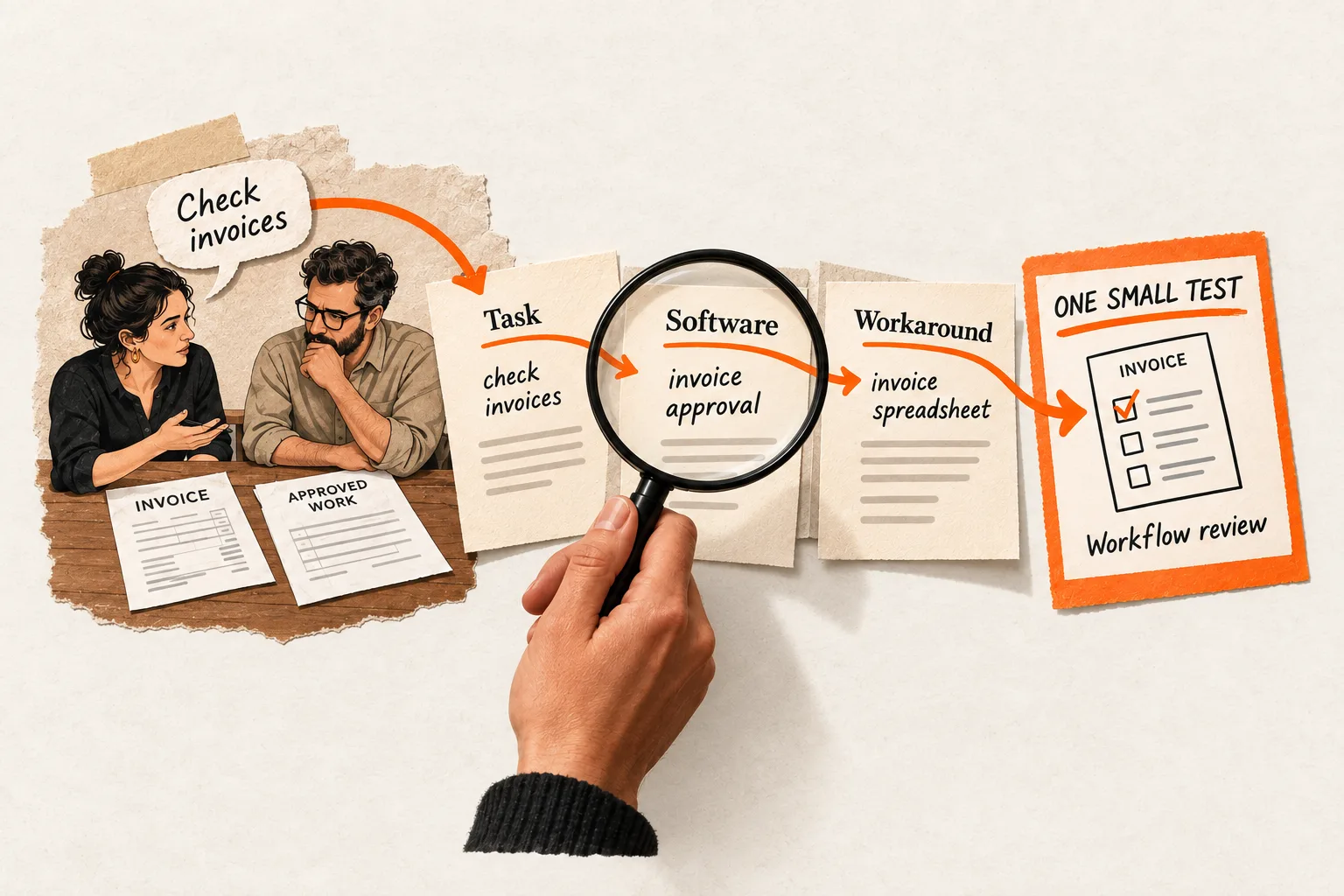
Choose one buyer and one recurring task. “Small businesses that want AI” gives you little to compare. “Customer success managers preparing account handoffs from support conversations” gives you a workflow to inspect.
Ask what that buyer would do without your product. They might use an incumbent’s built-in feature, paste notes into a general assistant, assemble a report manually, or leave the task unfinished. April Dunford’s positioning method starts with these alternatives, then connects differentiated capabilities to customer value and the customers who care about it. Her positioning guide explains that sequence.
In interviews, ask buyers to reconstruct the last time they did the task:
- What triggered the work?
- Which systems and people were involved?
- Where did they check or correct the output?
- What would have made the result unusable?
- Which alternatives did they seriously consider?
Record their wording separately from your interpretation, along with their role, workflow, and the source date. A complaint from an enterprise administrator may have little relevance to a founder managing ten accounts.
For review research, Joanna Wiebe’s method begins with the audience, desired outcome, and existing solutions before collecting language. Read her review-mining method. Use those inputs to find candidate messages. A vivid comment alone does not establish how common a problem is.
Copy the proof-matrix worksheet
Create one record per buying criterion. Copy this template into a worksheet and repeat it for each requirement you investigate.
| Field | Your entry |
|---|---|
| Buyer and requirement | [Role, recurring task, and constraint; link to the buyer research] |
| Current alternative | [How the buyer handles the task today] |
| Product behavior | [Specific capability you can show] |
| Expected buyer value | [Why it matters; mark benefits you have not measured] |
| Evidence and status | [Link, date, version, and status for each claim] |
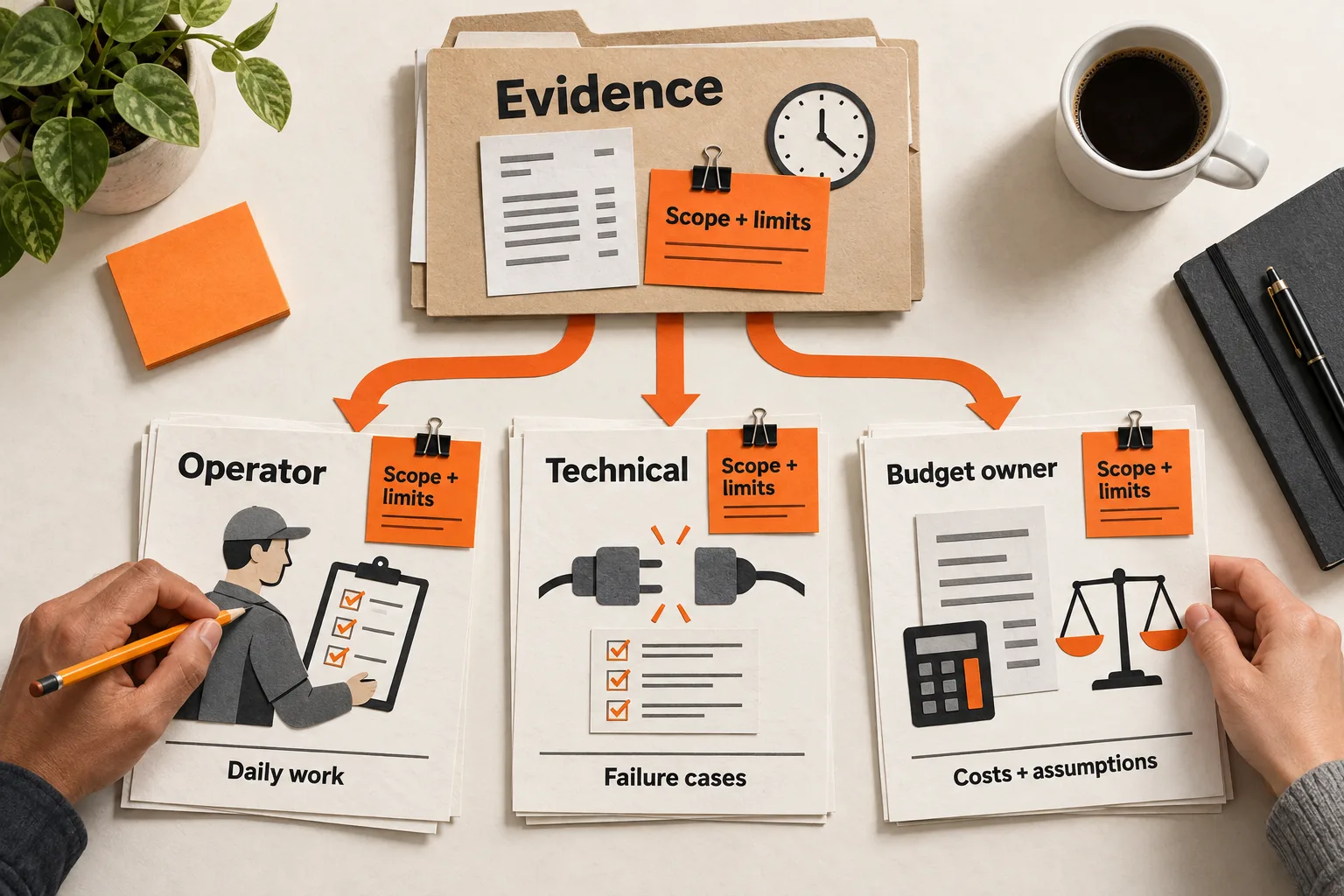
| Boundary | [Supported conditions, exclusions, and known failures] |
| Next action | [Missing evidence, test, owner, and review date] |
Label each evidence item demonstrated, documented, or unverified. A feature described in documentation has a different basis from a workflow you tested. One successful demonstration also leaves other conditions untested, so keep its scope beside the label.
Apply the same standard to alternatives. If a competitor’s public documentation does not answer a question, record “not verified.” That gap does not establish that the competitor lacks the capability.
A demonstrated capability gives you something concrete to describe. A claim of superiority also needs evidence about the alternative under comparable conditions.
Show where your product fits the workflow
Map the task from its trigger to the accepted result, including preparation and cleanup outside your interface.
For an account handoff, that might mean selecting an account, collecting relevant conversations, resolving conflicting details, drafting a summary, obtaining approval, and saving the result where the next person works.
Your difference may be narrow: preserving source links beside each handoff item, for example. Explain which review step that supports. To claim time savings, measure the review process, including corrections. A faster draft can still require more total work.
Compare approaches on the same task, giving each the information and setup it would reasonably receive. Record setup effort separately from recurring effort so a one-time configuration cost remains visible.
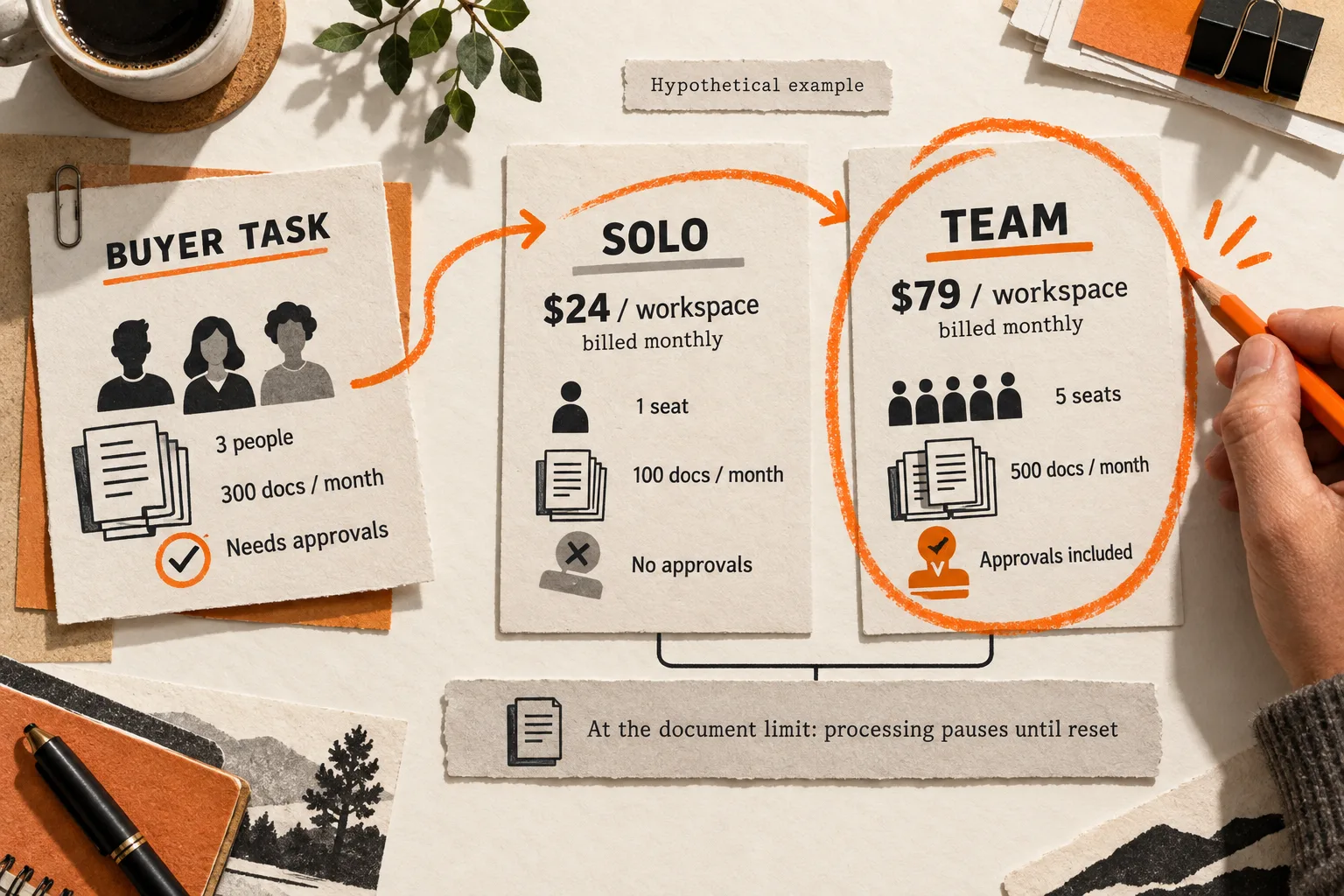
If the buyer’s existing tool already handles the task adequately, your proposed advantage may be too small to justify switching. Keep that finding in the matrix; it can change which audience or requirement you pursue.
Describe integration depth beyond the logo
“Integrates with your CRM” leaves several buying questions unanswered. Record which objects and fields the connection reads, what it writes, how permissions work, and whether a person must approve changes. Show how users discover a failed or delayed update.
Platform constraints belong in this record. For example, Slack documents method-specific rate limits. When a request exceeds a limit on its HTTP-based APIs, Slack returns a 429 response with a Retry-After header specifying how long to wait. Slack’s rate-limit documentation describes the response.
For a product that claims dependable synchronization, use that constraint to design a recovery test. Demonstrate what happens during throttling, interruption, and recovery, including what the user sees while work is incomplete.
Integration depth also brings maintenance work. Custom fields, permission changes, and recovery paths need attention as systems change. A simple export may be sufficient for a buyer who performs the task once a month. Choose integration claims around the work your target buyer needs.
Make reliability claims specific enough to test
Replace “accurate AI” with a defined acceptance rule. For a handoff assistant, a usable result might require correct account attribution, factual statements supported by the records, and explicit handling of missing information.
Anthropic’s evaluation guidance recommends specific, measurable criteria and tests that reflect the application’s tasks, including edge cases. Its evaluation guide explains these principles.
Record the product version, test date, input selection, grading rule, and sample size. Include difficult inputs, such as conflicting records or missing fields, and report those cases separately from routine work.
Track output quality and operational completion separately. A correct summary that never reaches its destination needs a different fix from a delivered summary with invented details. Record human correction effort as well.
Choose acceptance thresholds with the buyer before running the evaluation. Reserve some cases that the team will not use while developing the system, then evaluate against those cases. Repeat relevant checks when the model, prompt, retrieval process, or integration changes.
Label internal evaluations as internal. A small test supports a bounded statement about the cases tested; it cannot establish universal reliability.
Worked example: an account handoff assistant
Consider a fictional product called Handoff Notes. The capabilities and test results in this example are hypothetical.
Its initial pitch is “An AI-powered assistant for customer success.” The team narrows its candidate audience to customer success managers preparing weekly account handoffs from support records. Their current alternative is manual copying into a CRM note.
The team first identifies what to check:
| Criterion | Proposed behavior to verify | Boundary to disclose |
|---|---|---|
| Workflow fit | Each handoff item links to its source | Only connected support records are included |
| Integration depth | An approved draft saves to the selected account | Custom objects are unsupported |
| Reliability | Review checks account attribution and factual support | Human approval is required |
Suppose the team tests 40 account packets held out of development. Reviewers accept 34 drafts without factual correction. Four need factual edits, and two produce no draft because required information is missing.
A completed reliability record would look like this:
| Field | Hypothetical entry |
|---|---|
| Buyer and requirement | Customer success manager needs handoff facts attributed to the correct account and supported by records |
| Current alternative | Manual copying into a CRM note; baseline performance unverified |
| Product behavior | Generates a draft for human review; produces no draft when required information is missing |
| Expected buyer value | Less factual correction work; unverified until compared with manual work |
| Evidence and status | Internal test: 34 of 40 accepted without factual correction, four needed factual edits, two produced no draft |
| Boundary | Results apply to these packets; time savings and delivery reliability were not measured |
| Next action | Assign a test owner and date; compare manual work on the same packets and record correction effort |
In a real worksheet, attach the test record and its date, version, and grading rule. The illustrative counts above are not evidence for any product.
Report all three outcomes. Omitting the drafts that needed edits or were not produced would hide correction burden and incomplete work. Also distinguish an appropriate refusal to draft from an unexpected failure: the acceptance rule should define when missing information requires the system to stop.
After verifying that the source links work, the team could test this headline:
Prepare account handoffs with source links your team can review.
Supporting copy could describe where approved drafts save and disclose the custom-object exclusion once those behaviors are verified. An evaluation note could report the internal test separately, without implying that it established integration reliability or time savings.
Before claiming an advantage over manual work, the team still needs a comparable baseline. If manual handoffs require fewer corrections and little effort, the product may need improvement or a different audience.
Test whether the proof changes the buying decision
Show the proposed message and its evidence to people who match the chosen workflow. Ask them to explain what the product does, where it would fit, and what they would need to verify before trying it.
Record comprehension separately from preference. Someone can understand the claim and still prefer their existing tool because of price, an unsupported integration, review burden, or insufficient value.
Choose a meaningful next step for the test, such as agreeing to evaluate the product on a relevant task. Clicks and compliments may suggest questions to investigate; they do not establish willingness to switch.
When the evidence is ready for a public comparison, use FindVex’s SaaS comparison page outline to organize it around the buyer’s use case. Keep the proof matrix as the underlying record and revisit claims when capabilities change.
Complete one row before changing your homepage
Choose the claim most likely to influence a buying decision. Fill in its buyer requirement, current alternative, product behavior, and expected value. Attach evidence, state its limits, and mark competitor details you have not verified.
Then decide what result would justify keeping the claim. Assign the next test an owner and a review date. If the evidence field is empty, make designing that test the task for this session. Write the headline once you know what the result supports.