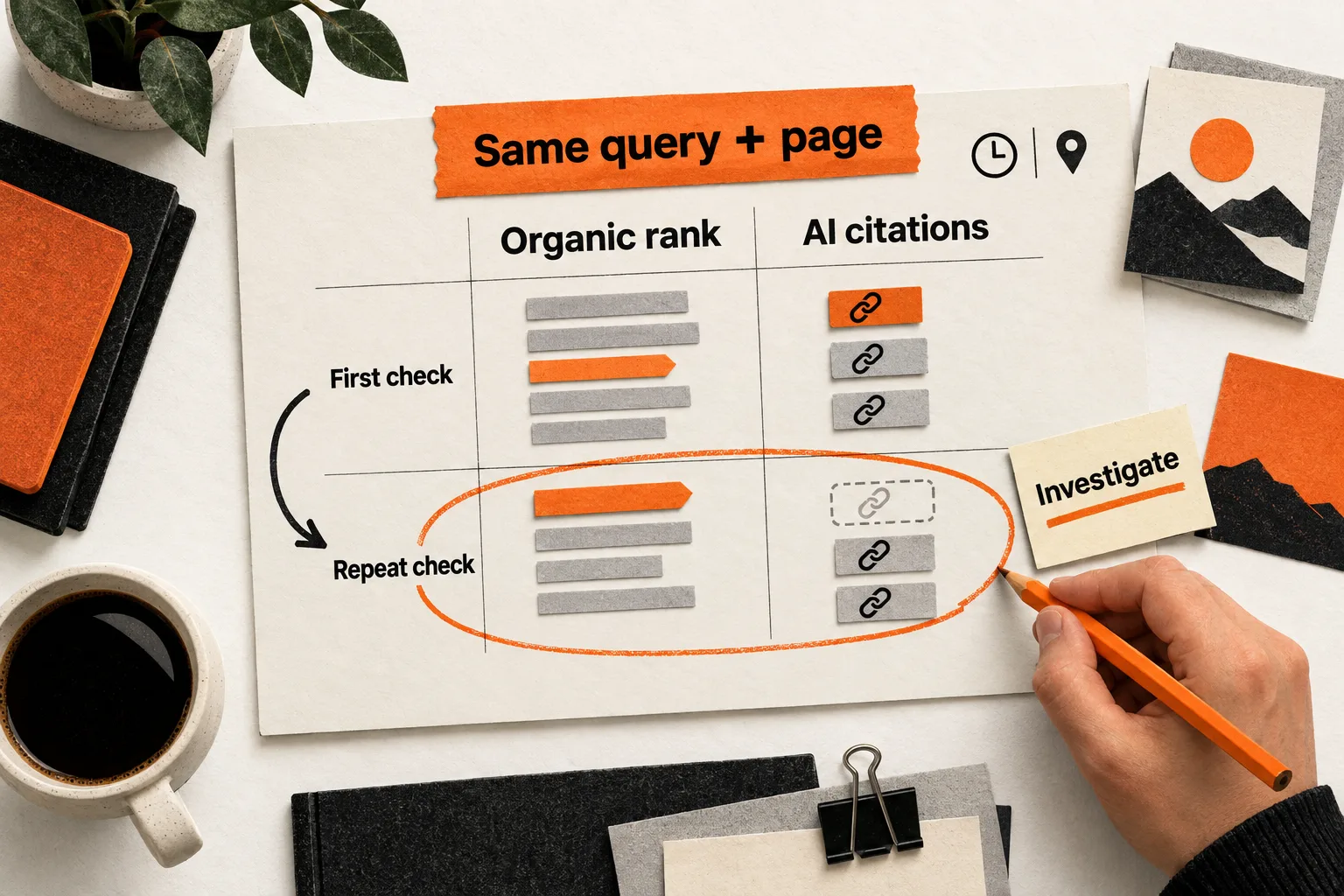
To compare AI Overview citations with organic rankings, record both from the same search result, then repeat the check under consistent conditions. The goal is a short list of disagreements worth investigating before you change a page.
Suppose your product guide moves from fifth to third in Google’s organic results, but its link disappears from the AI Overview. A weekly ranking average and a citation screenshot from Tuesday cannot establish whether those changes happened together. You need observations matched by query, search conditions, and time.
Define the two observations before collecting them
For this exercise, organic rank means a page’s position among the ordinary organic text results you inspect. Count those results separately from ads, AI Overviews, featured snippets, and other search features. Choose an inspection depth, such as the first 10 organic results, and keep it fixed.
An AI Overview citation means a link to the target page within the Overview’s supporting sources. A brand name without a link is a mention; record it separately if useful. A third-party review mentioning your product also differs from a citation to your own site.
Compare exact pages first. If your guide ranks organically but your documentation is cited, record both URLs. You can summarize visibility for the whole site later without concealing that difference.
Google says AI Overviews may use query fan-out: related searches across subtopics and data sources. This offers a possible explanation for supporting links that differ from the original query’s organic results. It does not explain why a particular page received or lost a citation. Google’s AI features documentation
Choose a small, fixed query sample
Start with 12 to 20 queries tied to decisions your prospective customers make. This is a manageable diagnostic sample, not a representative survey of Google Search.
For an AI meeting assistant, the sample might cover extracting action items, comparing transcription tools, and handling meeting recordings. Use actual customer questions where you have them. Keep the customer’s original wording alongside any search phrase you derive from it.
Include queries where your pages rank well, queries where they rank poorly or fall outside your inspection depth, and queries where you have not seen an Overview. Selecting only searches where you already appear in both places would hide disagreements.
Separate branded and nonbranded queries in your summary. Someone searching for your product’s name has a different task from someone asking how to solve a problem.
Choose a target URL for each query before the first check, and keep that pairing fixed. Record other pages from your site in separate fields. Otherwise, switching the target to whichever page appears could conceal a citation loss.
Freeze the query list for the initial observation period. Save new ideas for a later sample so changes in the questions do not masquerade as changes in visibility.
Capture both measures from one result page
Run each query in Google’s standard results view and capture its organic results and AI Overview in the same visit. Keep AI Mode outside this sample.
Use English, the same US location and device type, and a consistent sign-in and personalization state. Record the location Google displays. Turning personalization off does not remove location, language, or device context, and results can also differ with timing. Why Google Search results differ
Write down a repeatable inspection procedure. For example, record the initially visible Overview, expand it, and inspect the available supporting links. Save the URLs and screenshots of the states you inspected. Note whether the target citation was initially visible or appeared only after expansion. Choose a consistent wait limit and record loading failures.
Use four citation states:
| State | What to record |
|---|---|
| Cited | The target URL appears in the inspected supporting links. |
| Not cited | The source inspection is complete under your procedure, and the target URL is absent. |
| No Overview | The search completes without an Overview appearing under your procedure. |
| Unknown | Loading or inspection fails before you can determine the citation state. |
If you find the target link before another part of the source list fails, you can record it as cited, but mark the source inspection incomplete. If you do not find it before the failure, record unknown. An incomplete inspection cannot establish absence.
Google says Overviews do not trigger for every query, so a completed search without one needs its own category. Google’s explanation of AI features
As a starting schedule, check twice a week for four weeks, using the same time window and query order. This is a workload choice, not a statistical threshold. Label any extra checks separately and retain the scheduled observations even when an extra check produces a more interesting result.
Copy the paired query worksheet
Use one row per fixed query and target URL at each check. Store long URL lists and screenshots in linked evidence cells if necessary.
Query ID and exact query:
Original customer wording, if available:
Buyer task; branded or nonbranded:
Check date, time, and time zone:
Scheduled or additional check:
US location; language; device:
Sign-in and personalization state:
Fixed target URL:
Organic inspection depth:
Organic rank: number / outside inspected depth / unknown
Other URLs from our site in organic results:
Overview present: yes / no / unknown
Source inspection: complete / incomplete / not applicable
Target citation: cited / not cited / no Overview / unknown
Target link visible initially or after expansion:
Other URLs from our site cited:
All inspected citation URLs:
Inspection procedure, wait limit, and screenshot references:
Known page changes since previous check:
Observation:
Possible explanation to investigate:
Preserve raw URLs. If you remove tracking parameters or text fragments for matching, keep both the original and normalized versions. Do not merge different pages merely because they share a domain.
Use “outside inspected depth” only when you finished inspecting that depth. If the organic results fail to load, use “unknown.” Neither state establishes that the page is absent from Google’s index, and neither should be assigned rank 11.
Keep observations and explanations in separate fields. “Guide stayed third; citation disappeared” is an observation. “Google now prefers a more detailed source” is a hypothesis to investigate.
Read the disagreements: a hypothetical example
Suppose a fictional meeting-assistant team checks four fixed query and target-page pairs on Monday and Thursday. Both rounds use the same setup and inspect the first 10 organic results. All inspections finish successfully. The task labels below abbreviate the exact queries saved in the worksheet.
| Query task | Organic rank, Mon → Thu | Citation, Mon → Thu |
|---|---|---|
| Extract action items | 5 → 3 | Cited → Not cited |
| Compare transcription tools | 8 → 8 | Not cited → Cited |
| Summarize sales calls | Outside 10 → Outside 10 | Cited → Cited |
| Handle recording consent | 4 → 4 | No Overview → No Overview |
The action-item guide improved organically while losing its citation. Recheck the captured URLs and inspect whether the Overview addressed a different part of the question. The rank change alone does not explain the citation change.
The transcription comparison gained a citation with no organic rank change. That is a gain in this sample, but the observations do not establish that the team caused it.
The sales-call page remained cited despite falling outside the inspected organic depth. Its actual organic position is unknown. The recording-consent query produced no Overview on either day, so there was no citation opportunity to inspect.
On both days, two of the three queries with an Overview cited their target page. Citation coverage stayed at 2/3 even though one query gained a citation and another lost one. Across all four completed checks, coverage was 2/4. The unchanged totals conceal the changes visible in the paired rows.
Summarize coverage and changes separately
For each scheduled round, report checks attempted, completed organic inspections, Overviews observed, completed source inspections, and unknown citation states. Keep confirmed citations from incomplete inspections visible in the raw record, but exclude those incomplete inspections from the coverage calculations below.
Use two explicitly labeled measures:
| Measure | Calculation |
|---|---|
| Target-page citation coverage among inspected Overviews | Cited checks with complete source inspection ÷ all checks with complete source inspection |
| Target-page citation coverage across completed citation checks | The same numerator ÷ complete source inspections plus completed searches with no Overview |
The hypothetical example produces 2/3 and 2/4, respectively. If a denominator is zero, report the measure as unavailable. Always show the counts alongside the fraction so a changing denominator is visible.
For citation gains and losses, compare only query pairs with complete source inspections in both rounds. Report transitions to or from “no Overview” separately, and flag pairs excluded because an inspection was incomplete.
Compare numeric organic positions only when both are known. Keep transitions into or out of the first 10 as categories, and retain organic inspection failures as unknowns.
For a small sample, individual cases and counts are usually more useful than a correlation coefficient. Repeated checks of the same queries are not independent observations, and a handpicked list cannot establish a universal relationship between rankings and citations.
Keep Search Console and business outcomes alongside the sample
Search Console average position differs from the organic rank defined here. It aggregates positions across impressions, and Google assigns every link within an AI Overview the position occupied by that Overview. Search Console’s measurement definitions
Traffic from AI features is included in the standard Performance report’s Web search type. Google’s performance reporting guidance
Search Console also has a Generative AI performance report for Search that includes impressions from AI Overviews and AI Mode. Its documented dimensions include pages, countries, dates, and devices, but do not include queries. It therefore cannot supply the same-query observations in this worksheet. Google’s Generative AI report documentation
For more reporting context, read Can Search Console separate AI Overview traffic?.
A citation in your manual check does not establish that customers saw it, clicked it, or became qualified users. Review search clicks and meaningful product outcomes separately. This sample alone cannot attribute their changes to citations.
Your next task: record the first paired check
Choose 12 to 20 queries, assign each a fixed target URL, and complete the worksheet for the first scheduled round. Save the search evidence and schedule the remaining checks.
After four weeks, choose one recurring disagreement to investigate. Inspect the saved results and relevant pages, then write down a proposed change and its benefit to the reader. Record when you make it and continue the same sample. Describe what changed while keeping the cause open unless you have evidence to establish it.