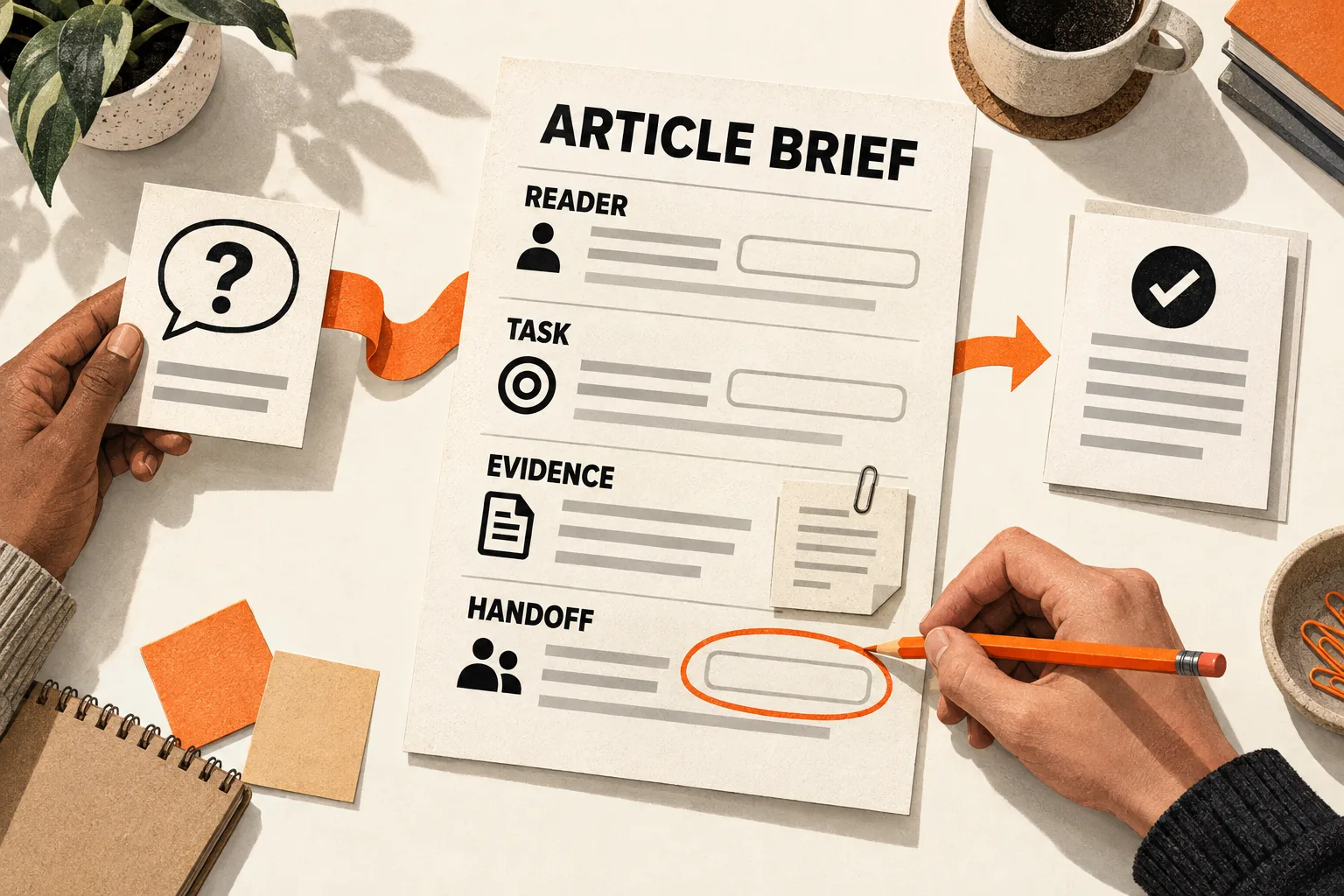
Plan your next LinkedIn sequence around a decision your buyer is struggling to make. Identify the concern behind the hesitation, gather evidence that could answer it, and give each post one part of the explanation.
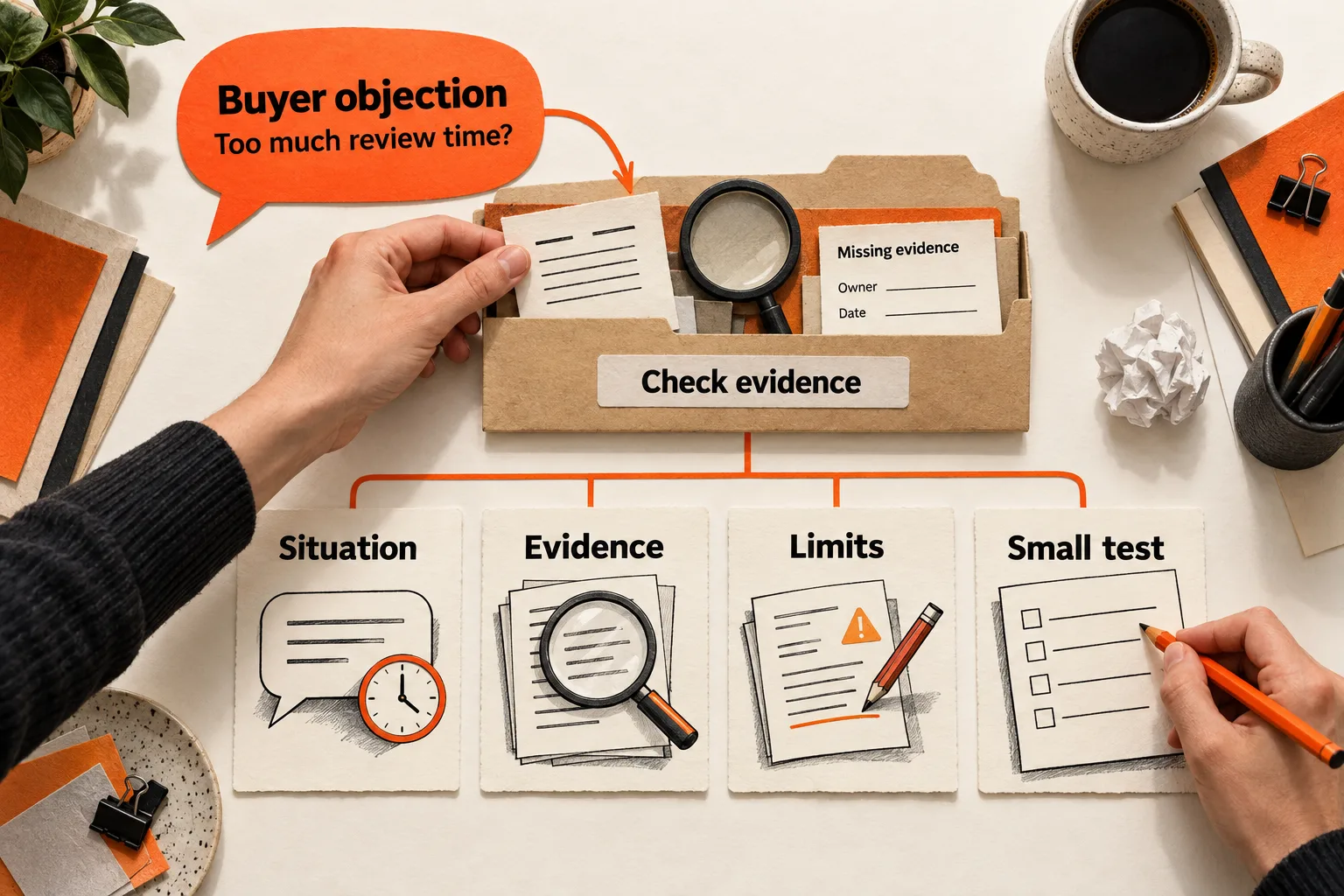
For an AI support tool, that concern might be simple: reviewing generated replies could take longer than writing them. A feature walkthrough helps only if it addresses that work. The sequence should help the reader decide whether a trial makes sense, including when it doesn’t.
Choose an objection you can investigate
Start with a narrow audience and a stalled action. For example, a support manager at a small SaaS company wants faster replies but hesitates to evaluate an AI drafting tool because reviewing its output could take too long.
Separate three things in your notes:
- Observation: what someone actually said or did, with its source and context.
- Interpretation: the belief you think explains the hesitation.
- Unresolved question: what you need to learn before writing.
A question about implementation time could reflect limited staffing, a bad previous rollout, or a fixed deadline. Each calls for a different answer.
Joanna Wiebe’s review-mining method starts with the audience, desired solution, and existing alternatives. It uses customer language to identify concerns and messages worth testing. Apply that listening discipline to conversations you have permission to use and public discussions relevant to your buyers.
Keep exact wording separate from your summary. A vivid complaint gives you a question worth investigating; it does not show how widespread the problem is. FindVex’s pain-point evidence sheet helps you record sources, workarounds, unknowns, and counterexamples.
Choose an objection for which you have a relevant observation and access to useful evidence. If the evidence is missing, collect it before drafting.
Define what the evidence could change
Write this sentence in your planning document:
For [buyer in a specific situation], the current assumption is [interpretation]. The evidence may support [narrower conclusion], provided [conditions].
Leave room for the buyer to decline. An AI tool might be worth testing on routine requests while remaining unsuitable for sensitive or ambiguous cases.
First, check whether the objection describes a real product limitation. If a buyer needs an integration you lack, explain the limitation and who can work without that integration. If the missing information is setup effort, document setup effort.
Also identify whose concern you are answering. The daily user might worry about review time while an approver worries about ownership and oversight. Edelman and LinkedIn’s 2025 B2B Thought Leadership Impact Report reports that hidden decision-makers also consume and evaluate thought leadership. Consider whether another stakeholder affects this decision, but don’t treat the report as evidence that your post sequence will influence them.
For a small team, begin with one role. Add another stakeholder only when their question affects the same decision.
Give each post one part of the explanation
Use four posts as a starting format. This is an editorial choice, with no claim about LinkedIn’s preferred frequency or format.
| Post | Purpose | What the reader should leave with |
|---|---|---|
| 1 | Describe the situation and concern | A specific question to investigate |
| 2 | Show evidence and explain how you obtained it | A conclusion they can inspect |
| 3 | Examine a boundary or counterexample | Conditions where the conclusion may fail |
| 4 | Offer a worksheet or small test | A way to evaluate their own situation |
Make each post understandable on its own. Restate the buyer’s task and relevant conditions where needed; the fourth post should make sense without the first three.
Choose the format after choosing the evidence. Use text to explain a decision rule, an annotated screenshot to show an actual workflow, or a worksheet to organize a comparison. A screenshot supports only what it visibly demonstrates. It cannot establish time savings across a customer’s operation.
Before drafting, write down what your evidence supports and what it leaves open. Keep labels such as “internal test” and “hypothetical calculation” attached when you turn the material into a post.
Worked hypothetical example: AI support drafting
The product scenario, sample wording, and numbers below are fictional. They illustrate the method and are not customer evidence.
Imagine a founder building an AI support-drafting tool for teams answering routine account questions. The hypothetical objection is that checking generated replies will consume any time saved on writing.
The conclusion to explore is narrow: measuring drafting, checking, and correction together can help a support manager decide which request types deserve a limited trial.
Post 1: Define the work being compared
Explain the difference between producing a draft and finishing a reply that is ready to send. Include fact-checking, rewriting, and escalation in the comparison.
Sample opening for this fictional example:
Before testing AI support drafts, measure the whole reply. A fast first draft can still leave a slow review.
Ask readers to list the steps between opening a routine ticket and approving the response. That gives them a comparison to use in the next post.
Post 2: Show the calculation and its limits
Label the numbers where readers will see them:
| Hypothetical workflow | Drafting or generation | Checking and correction | Total |
|---|---|---|---|
| Manual reply | 6 minutes | 2 minutes | 8 minutes |
| Assisted reply | 1 minute | 3 minutes | 4 minutes |
| Difficult assisted reply | 1 minute | 8 minutes | 9 minutes |
These invented figures illustrate how review time changes the total. They do not estimate the tool’s performance or show how often either assisted outcome occurs.
For an actual demonstration, use measured observations and explain how you selected the tasks, what work you timed, and the quality standard each reply had to meet. Keep results separated by request type so readers can see which work might belong in a trial.
Post 3: Explain a failure condition
Use a constructed case in which outdated reference material produces a draft that needs extensive correction. Walk through what the reviewer would need to detect and fix before sending it.
For a real product post, demonstrate that behavior only if you have verified it. Otherwise, present outdated reference material as a condition to test.
End with a task: identify which requests depend on information the team cannot reliably verify. Those requests may need to be excluded from the trial.
Post 4: Give readers the comparison sheet
Offer a small practice batch of comparable requests and make clear that it is exploratory. Readers can copy this table into a spreadsheet and add one row per comparison:
| Request type and task IDs | Manual total time | Assisted total time | Corrections needed | Final quality meets the agreed standard? | Escalation needed? |
|---|---|---|---|---|---|
| [Enter comparison] | [Minutes] | [Minutes] | [Describe] | [Record for each approach] | [Record for each approach] |
Record setup and training time separately. Define the quality standard before timing either approach, and include checking, correction, and escalation work in the totals. A few easy examples cannot support a blanket savings claim.
The reader’s next step is to complete the comparison and decide whether a broader evaluation is justified. Keep the sheet usable without a sales conversation.
Review buyer responses alongside post analytics
Decide what you want to learn before the sequence begins. For the hypothetical support tool, look for a relevant reader identifying which request types they would include in a trial and explaining why.
LinkedIn provides individual post analytics, including audience demographics and engagement categories that vary by post type. Your own views and engagements also count. Use those figures to describe activity around the posts, while keeping their limits in mind. LinkedIn’s post analytics guidance
For each post, record its URL, evidence, intended reader action, and substantive responses. Keep reach and reactions separate from statements about the buying decision. A like cannot tell you whether someone now trusts the workflow.
Choose a review date, such as two weeks after the final post. Treat that as an operating choice rather than a universal measurement window.
If relevant readers repeat the original objection, check whether your evidence answered it. A more specific concern can guide the next explanation. Responses mainly from peers outside the intended audience call for a closer look at whom the content reaches. Little response leaves the belief-change question unresolved.
Organic posts do not create a controlled experiment. Audience differences, timing, prior familiarity, and other interactions can affect responses. Even a reader who says a post changed their view provides an individual account, not proof of a general effect.
Copy this planning worksheet
Complete one block before writing the posts:
Buyer role and situation:
Decision currently stalled:
Observed objection and source:
Exact wording, if verified:
Our interpretation of the belief:
What remains unknown:
Narrow conclusion the evidence could support:
Conditions where that conclusion would not apply:
Evidence available and its limits:
Evidence still needed, owner, and collection date:
Evidence that would contradict our interpretation:

Post 1: Situation and reader task
Post 2: Evidence and method
Post 3: Boundary or counterexample
Post 4: Practical evaluation step

Useful response we will look for:
Post URLs and substantive responses:
Review date:
Decision after review: continue, revise, investigate, or stop
Before publishing, check that each post has one clear purpose, factual claims have adequate support, and invented examples are labeled wherever they appear independently.
Start with one objection and an evidence check
Choose one objection from your existing notes. Fill in the buyer, stalled decision, observation, and interpretation. Then write the narrow conclusion you could defend and locate the evidence for the second post.
If you cannot support that conclusion yet, assign the missing evidence an owner and collection date. Finish that task before drafting the sequence.