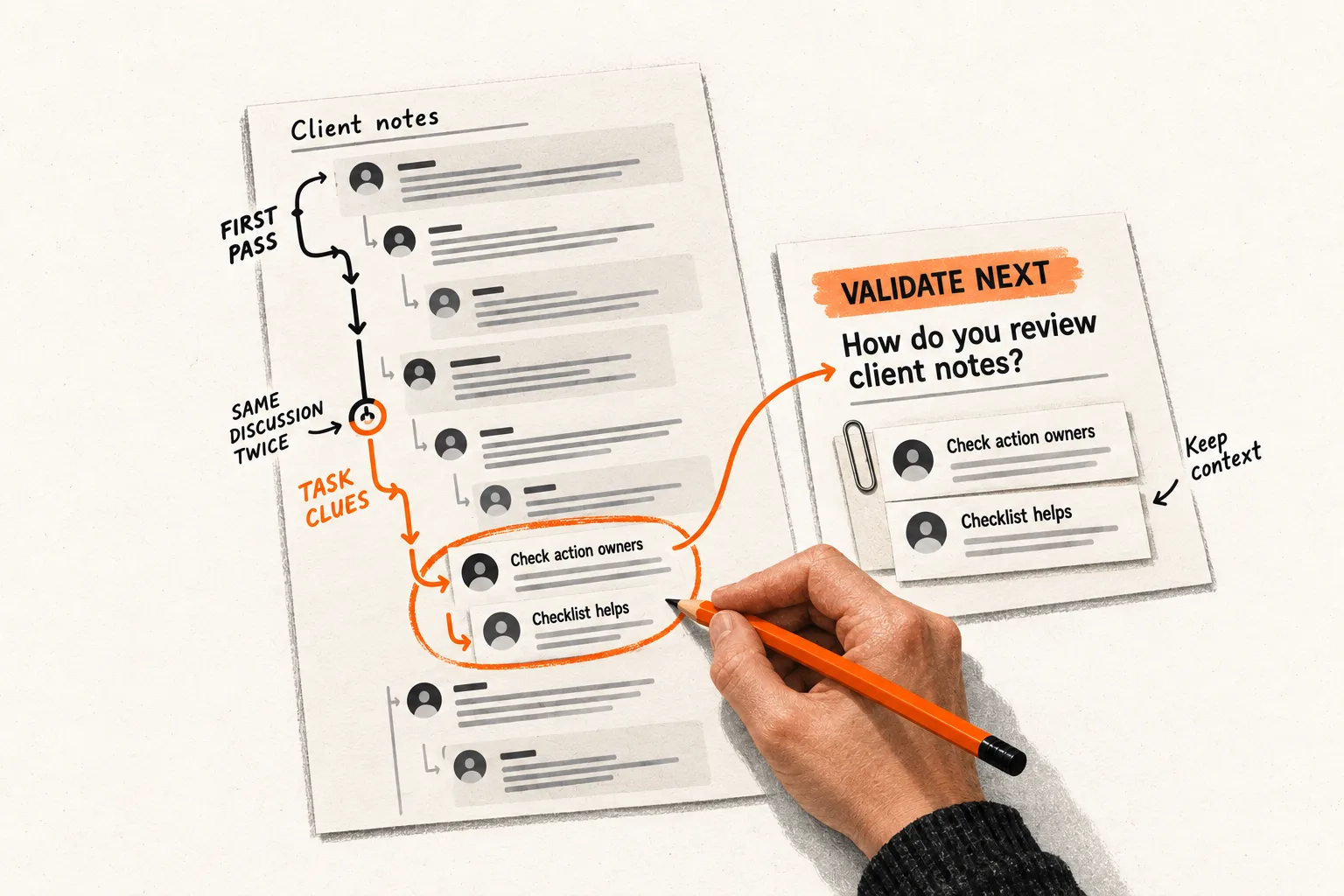
To research customer questions on YouTube and Reddit, read the same discussion twice: first in its displayed order, then by following clues about a specific task. Compare what each pass adds and keep the surrounding replies. This gives you questions to validate without treating a popular discussion as proof of demand.
Imagine researching an AI meeting assistant. Broad praise about saving time might offer little direction, while a less visible reply describes checking every action-item owner before sending notes to a client. That detail could suggest a useful help article. Its position in the thread does not establish how much it matters to your intended buyer.
Define relevance before opening the comments
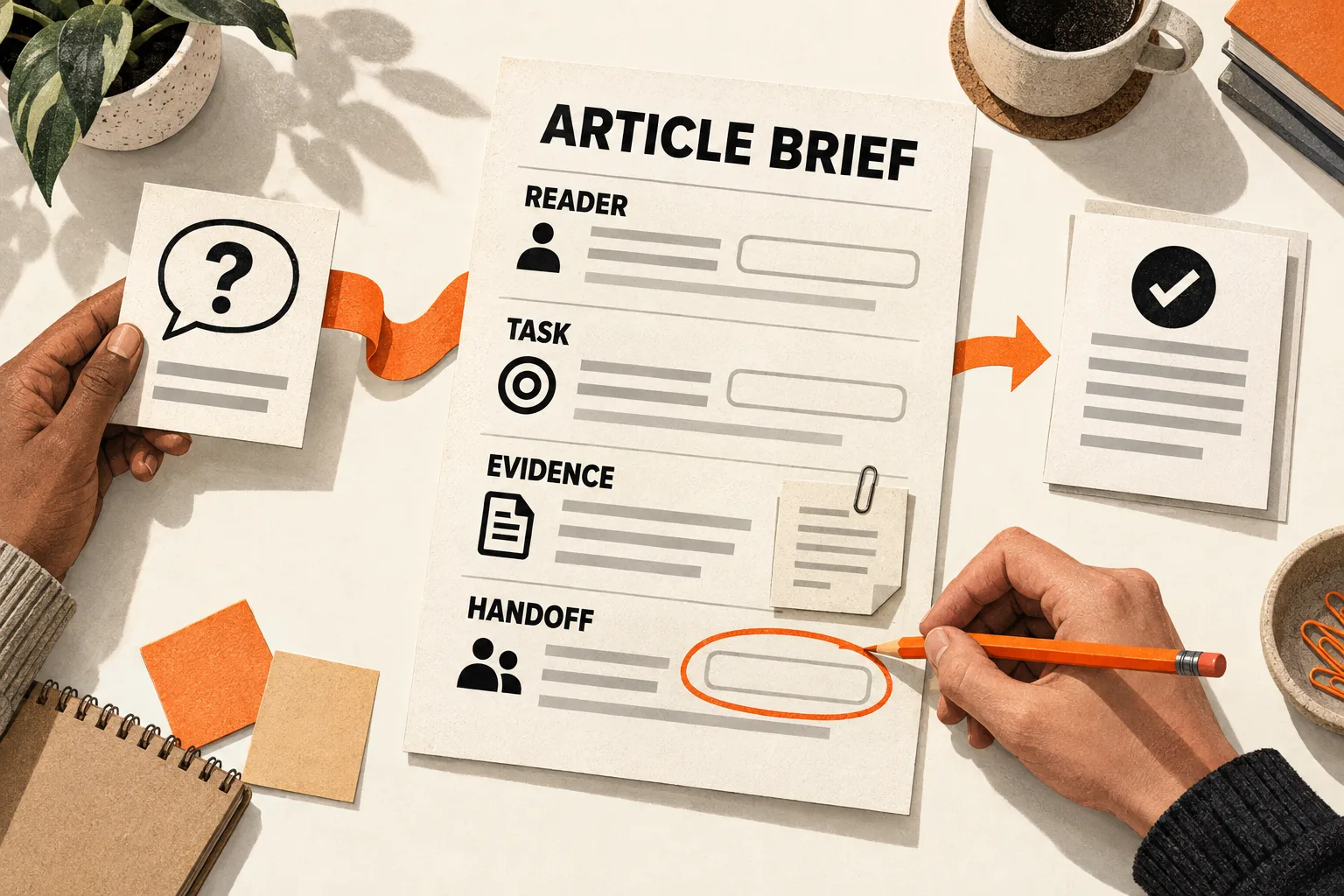
Write down the reader, the task, and the decision your research should support:
Research focus: Small agency owners reviewing AI-generated meeting notes before sharing them with clients. Decide which review problem deserves a practical help article.
A relevant comment describes a failed step, a workaround, a constraint, or a desired result within that situation. General enthusiasm about AI offers less help with this decision, even when it attracts more reactions.
Use the same labels in both reading passes:
| Label | When to use it |
|---|---|
| Directly relevant | Describes the target task and a specific problem or outcome, with enough context to establish audience fit. |
| Possibly relevant | Mentions the problem, but the person’s role or situation is unclear. |
| Outside scope | Concerns another task or provides no usable context, such as generic praise. |
Record audience fit as unknown when the comment does not establish it. English-language comments alone do not establish that someone is a US buyer.
Keep original wording separate from your interpretation. Repeated corrections do not necessarily mean someone wants a new product, would pay for one, or endorses your proposed solution.
Understand what the platform puts first
YouTube’s Top comments view uses signals including comment text, the viewer, and the video to select comments viewers are likely to value or interact with. Some comments may not appear in that view, so treat the first screen as a selected portion of the discussion. YouTube explains Top comments and visibility.
On YouTube’s web interface, the Sort By control offers Top comments and Newest first. Clicking a comment’s timestamp creates a shareable link to that comment and its thread. Save that link to preserve the context of a finding. YouTube’s comment guide documents both features.
Reddit lists Relevance, Top, and New as sorting options for comment search results. These are search-result controls; distinguish them from the order of replies inside a discussion. Reddit’s search sorting guide describes the options.
A platform’s Relevance setting cannot establish whether a commenter matches your target customer or whether their problem deserves your next week of work. Apply your own criteria after reading the surrounding exchange.
Compare two reading passes within a fixed budget
Choose a small set of discussions about the same task. For a starting exercise, try two Reddit threads and two YouTube videos, allowing five minutes per pass on each item. These limits keep the work manageable; they do not produce a representative sample.
Record why you selected each item. A tutorial about reviewing meeting notes fits the example task more closely than a broad video about the future of AI. Include different authors or channels where possible to avoid depending entirely on one audience.
First pass: read in the displayed order
Record the displayed sort setting, then read in that order for five minutes. Count each comment you inspect once within the pass, including replies you open. Save useful questions with their context and relevance labels. Tally directly relevant comments separately from possibly relevant ones; reactions should not determine the label.
Second pass: follow clues about the task
Return to the same item and look for concrete steps and constraints. For the meeting-notes example, clues might include incorrect owners, missing decisions, client review, and manual corrections. Open the surrounding replies whenever a comment seems useful.
On Reddit, search within a post’s comments using the search icon in the native apps or the comment search bar on desktop. Try short queries such as action items and corrections separately. Reddit’s documentation says comment searches currently require all query words, so longer queries can exclude differently worded accounts. Reddit’s search feature documentation explains these controls.
On YouTube, switch to Newest first and inspect another bounded portion of the conversation, including relevant replies. If the first pass already used that setting, record it and focus the second pass on replies about the task. A different view changes what you encounter; you still need to judge relevance yourself.
Use the same counting rule in both passes. Mark comments encountered in both so you can calculate how many additional relevant comments the second pass found. Keep replies that resolve a complaint or show that an existing method works.
The second pass benefits from what you learned in the first. It also combines more reading with a different search approach. This exercise measures additional discoveries within a time budget; it cannot isolate the effect of sorting. If you repeat it, alternate which approach comes first across discussions, while retaining that limitation.
Worked example: a correction narrows the article idea
The following example is fictional. Its counts and observations demonstrate the method, not customer results.
Suppose a founder selects four discussions about reviewing meeting summaries and records these totals across the four items:
| Measure | Initial reading | Targeted reading |
|---|---|---|
| Comments inspected, counted once within each pass | 40 | 32 |
| Directly relevant comments | 6 | 9 |
| Relevant comments also found in the initial pass | Not applicable | 3 |
| Additional directly relevant comments | Not applicable | 6 |
The targeted reading adds six relevant comments: nine minus the three already saved. Across both passes, the founder has 12 distinct relevant comments. These counts do not establish 12 different customers.
The initial reading mainly surfaces discussion of summary accuracy and time saved. Targeted reading finds an account of checking action-item owners against the recording. Another comment distinguishes rough internal notes from notes that need review before a client sees them. A reply says the team’s existing checklist already catches most errors.
Together, those observations suggest a narrower article question: How should an agency review action items before sending AI meeting notes to a client? The successful workaround belongs beside the complaint because a checklist may solve the immediate problem without another tool.
In this example, targeted reading adds useful detail within four discussions. It does not establish how common the issue is among agencies, whether targeted reading always works better, or whether anyone would buy a solution.
The next validation task is to ask agency owners about their most recent review process: what they checked, what they corrected, and what happened afterward. Compare those accounts with the public comments before deciding to build a feature or write broader positioning copy.
Copy a worksheet that preserves context and overlap
Use one session record for the comparison and one observation record for each saved finding. If you already use FindVex’s pain-point evidence sheet, add the reading-pass fields to that record.
RESEARCH SESSION
Target reader, task, and decision:
Source links and selection reasons:
Date reviewed and platform/interface:
Time limit and order of approaches:
Displayed sort settings and search terms:
Comments inspected in each pass:
Directly relevant comments in each pass:
Possibly relevant comments in each pass:
Relevant comments found in both passes:
Additional relevant comments from the second pass:
Missing context or inaccessible material:
Question to validate next:

INDIVIDUAL OBSERVATION
Observation ID:
Comment link and parent discussion:
Short original excerpt or labeled paraphrase:
Stated role and situation, or unknown:
Task, obstacle, and current workaround:
Relevance label and reason:
Pass where first found:
Seen again in the other pass? If so, link the same ID:
Replies that clarify, contradict, or resolve it:
Your interpretation:
Next validation question:
Count comments separately from distinct accounts and discussions. Several replies from one person may explain a problem in depth without representing several customers. Similar wording across platforms also does not prove that the accounts belong to different people.
State what the sample cannot tell you
Both passes remain selective. Top views reflect platform choices; newer views favor recent contributions; keyword searches favor the vocabulary you anticipated. Reading deeper can uncover useful detail while drawing you toward unusual edge cases.
Source selection adds another limit. An advanced tutorial may attract people with different needs from beginners, and a competitor’s channel may attract existing users. Public comments leave out people who encountered the task and never posted about it.
Switching sorts cannot recover every missing comment. YouTube documents removals and channel moderation, including comments held for approval and blocked words. Treat the visible discussion as incomplete. YouTube’s moderation and visibility explanation describes these limits.
Before turning a finding into content, reread the surrounding replies and check that the question fits a reader and task you can name. Resolve duplicate captures, retain successful workarounds and contradictory accounts, and verify any product capability you plan to mention separately. Choose a next step that the evidence can support, such as a focused conversation or a help article.
Start with one discussion today
Spend five minutes reading its initial view and five following clues about your chosen task. Save a useful question with its context if you find one. Record any counterexample and one unresolved uncertainty; if no counterexample appears, mark that explicitly.
Finish by choosing the next action your notes justify. That might be asking a customer to walk through the task, outlining a focused help article, or finding a better-matched discussion when the first one offers too little context.