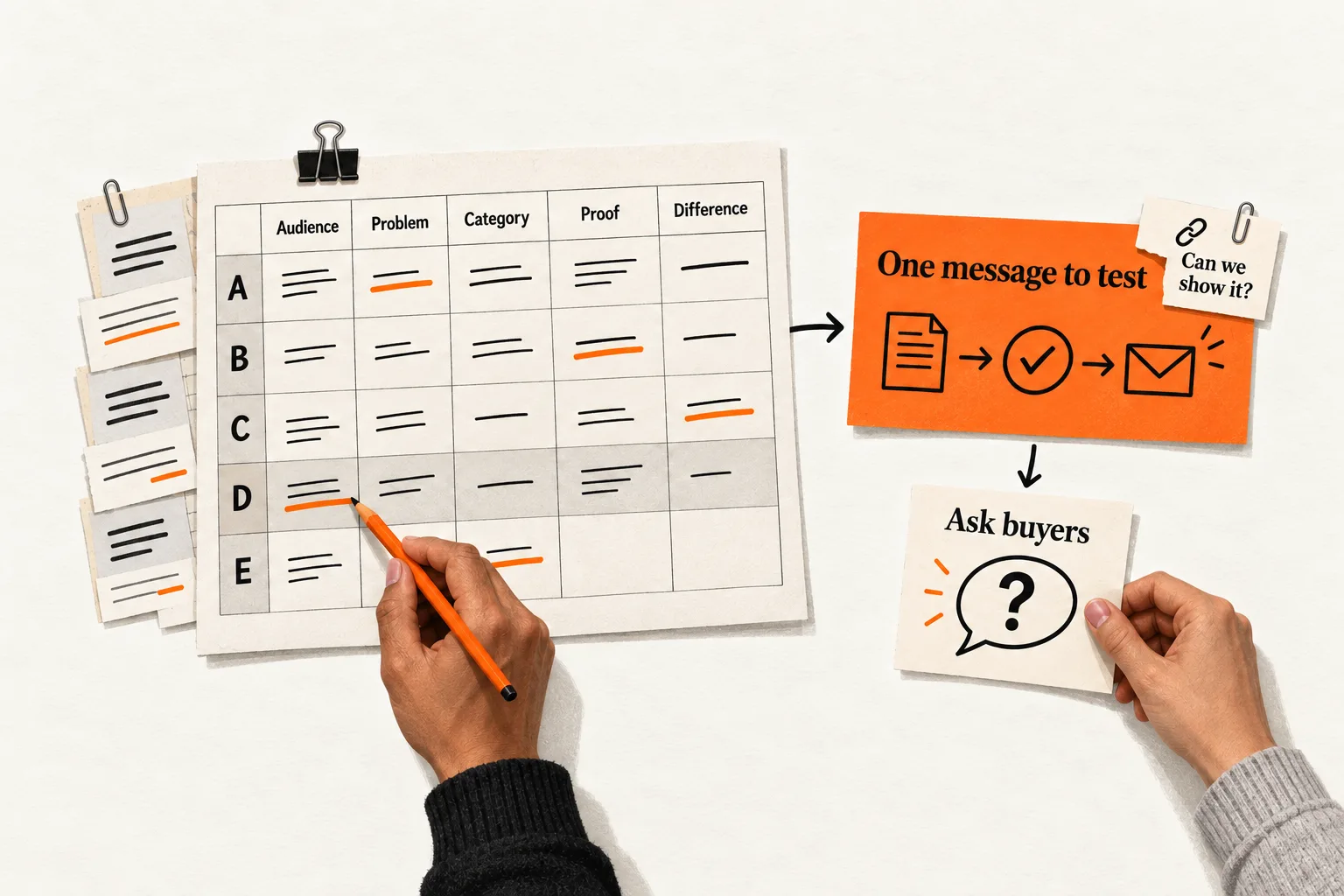
Use this competitor messaging audit template to compare five companies across audience, problem, category, proof, and differentiation. The goal is to leave with one candidate message your product can support and a clear question to investigate with buyers.
Set aside about three hours for a first pass: 20 minutes to choose companies, 75 to inspect their pages, 30 to compare findings, and 30 to 45 to write a test plan. This is a suggested budget. Resolving the unanswered questions may take longer.
Choose five companies around one buyer decision
Write the decision at the top of your sheet. For example: “A support lead at a small SaaS company needs to handle repetitive questions without adding another full-time agent.”
Choose five companies that offer plausible alternatives for that decision. Start with names buyers have mentioned in conversations, evaluations, or lost deals. If you have no customer evidence yet, mark the selection provisional and record why each company belongs.
April Dunford recommends starting positioning work with the alternatives customers would actually use. These can include a manual process or doing nothing; a similar vendor may never enter the buyer’s consideration. Her positioning guide explains why that distinction matters.
Keep five companies in the main comparison and note the current workaround separately, such as a shared inbox and saved replies. Five is a manageable sample, not a representative picture of the market. Replace any company that serves a fundamentally different buyer. Afterward, audit your own messaging with the same fields.
Collect comparable evidence from each company
Spend about 15 minutes per company. Review its homepage, the product or use-case page closest to your buyer decision, and one relevant source of supporting detail: documentation, a demo, or a customer story.
Capture the headline and supporting sentence before summarizing them. Beside each observation, save the page URL, date checked, and section. Keep these excerpts in your internal notes; the comparison does not require republishing competitors’ copy.
Label each observation:
- Observed: the page states or shows it directly.
- Inferred: your interpretation of the wording or presentation.
- Not found: absent from the pages you inspected.
“Not found” describes the limits of your search. It does not establish that a product lacks a capability.
Record where each message appears. A capability buried in documentation plays a different messaging role from a promise leading the homepage.
Copy the five-company messaging matrix
Use one row per company. Keep entries short and link them to evidence notes using IDs such as A1 or B2. Add an evidence label to each entry so interpretations remain visible when you read across the sheet.
| Company | Audience | Problem and promised outcome | Category | Proof offered | Claimed differentiation |
|---|---|---|---|---|---|
| A | |||||
| B | |||||
| C | |||||
| D | |||||
| E |
Audience: Record the named role, company type, and situation. Enterprise customer logos alone do not establish that smaller companies are excluded.
Problem: Preserve the original level of specificity. “Reduce manual tagging” is narrower than “improve productivity.” Vague wording is part of the observation; avoid making a competitor’s promise more precise in your summary.
Category: Capture the company’s own label. “Help desk,” “AI support agent,” and “workflow automation” suggest different comparisons even when features overlap.
Proof: Connect the artifact to the claim it supports. A demo may show that a workflow exists. A customer story may support an outcome in one setting. Neither automatically establishes typical results. Note missing context, including the baseline, timeframe, or conditions.
Differentiation: Record the stated reason to choose the product and the alternative it is compared with. Then assess whether the evidence supports that reason. A feature’s presence does not prove exclusivity.
Use this companion record for the evidence behind each row. It also works as a standalone template if you prefer a document to a wide spreadsheet.
Company / row ID:
Reason for inclusion in this buyer decision:
Pages inspected and date checked:

Evidence ID:
Page URL and section:
Exact headline or short supporting excerpt:
Field supported: audience / problem / category / proof / differentiation
Evidence label: observed / inferred / not found
What this supports:
What remains unknown:
Repeat the evidence block as needed. For “not found,” list the pages inspected and the detail you were looking for.
Compare patterns without turning gaps into conclusions
Reserve 30 minutes to read across the completed matrix. Look for repeated promises, differences in audience, and claims whose supporting evidence is thin.
A repeated promise may be something buyers expect every acceptable product to deliver. You may still need to communicate it. Repetition alone is no reason to abandon it.
An empty cell is a research lead. If none of the five companies emphasizes approval controls, buyers may not care, the capability may be assumed, or the message may appear elsewhere. The sheet cannot tell you which explanation is right.
Bring buyer evidence into the decision. Joanna Wiebe’s review-mining method starts with the audience, desired outcomes, and solutions people already use. In her Flow example, recurring review concerns become questions for the developer about what the product can support.
Keep buyer wording separate from your interpretation. Record who expressed the concern, their situation, and the source. A handful of public comments can suggest an interview question without establishing how common a need is. Use the pain-point evidence sheet to organize those observations alongside your competitor notes.
Choose a message to investigate when you can connect a plausible buyer need to a demonstrable capability and explain why it matters against a relevant alternative. Leave missing buyer evidence visible in the decision note.
Worked example: approval before sending
The companies, observations, and product capabilities below are entirely fictional. They illustrate the worksheet; they are not findings about real vendors.
Suppose your product helps small SaaS support teams draft replies. Your provisional shortlist contains these abbreviated records:
| Company | Audience | Problem | Category | Proof offered | Claimed differentiation |
|---|---|---|---|---|---|
| A | Support managers | Repetitive tickets | AI support agent | Autonomous-resolution demo | Handling work without an agent |
| B | Operations teams | Disconnected tasks | Workflow automation | Integration walkthrough | Connecting business systems |
| C | Small support teams | Managing a shared queue | Help desk | Assignment and tagging demo | Keeping daily work together |
| D | Support agents | Searching internal material | Knowledge assistant | Answers linked to documents | Finding supporting information |
| E | Larger service organizations | Inconsistent processes | Service platform | Deployment story | Administrative controls |
Before treating this as a useful comparison, check the selection. Company E may serve a different buyer, while B belongs only if buyers consider broader automation for this support task. Replace either if you cannot justify its inclusion.
Your fictional product drafts replies with source links and requires an agent to approve each send. Its current headline is “AI that transforms customer support.” A candidate replacement is:
Draft support replies with source links. Your team approves every send.
The product can demonstrate that promise. Mandatory approval also creates a tradeoff: teams seeking fully autonomous resolution may find it unattractive.
The matrix does not establish that approval is unique or widely desired. Check whether relevant alternatives offer comparable controls, then investigate whether intended buyers see review as reassurance or extra work.
For this example, the next test could show a draft page to support leads without an explanation. Ask what they expect to happen between drafting and sending a reply. If they expect automatic sending, revise the wording. If they understand the workflow but want to eliminate manual review, investigate whether the audience or proposed benefit is a poor fit. These are possible decision paths, not reported test results.
Write a decision note for one message test
Use the final 30 to 45 minutes to complete this note:
Intended reader and immediate situation:
Current alternative:
Candidate headline and supporting sentence:
Product evidence supporting the promise:
Buyer evidence supporting its relevance, or evidence still needed:
Main uncertainty or tradeoff:
Exact page version to show:
Test method:
Observation that would make us revise or drop the message:
Owner:
Review date:
Show the candidate page to people who match the intended audience without explaining it first. Ask them to describe what the product does, who it serves, what they expect next, and which claim needs more evidence.
Wynter’s messaging-audit guidance recommends questions about headline clarity, missing product information, and benefit relevance. Use those questions to investigate how buyers understand the message.
Save responses against the exact version each person saw. Look for misunderstandings and unsupported expectations. A few conversations can reveal problems to investigate; they cannot establish a conversion lift or market-wide preference.
If you later test the message on a live page, define the useful outcome in advance, such as a qualified trial reaching its first completed task. Account for traffic sources and other page changes when interpreting results. With little traffic, begin with comprehension research and product demonstrations before drawing conclusions from clicks.
Start with one company record
Complete the first company’s row and evidence notes before collecting the remaining four. Check whether you can trace every important entry to a page and distinguish the company’s statement from your interpretation. Adjust the sheet while the corrections are still small.
Then finish the comparison and choose one candidate message. Before changing your homepage, confirm that your product can demonstrate the promise, record the buyer evidence still needed, and assign someone to the next test with a review date. Your afternoon’s deliverable is a completed matrix and a decision note with an unresolved question worth investigating.