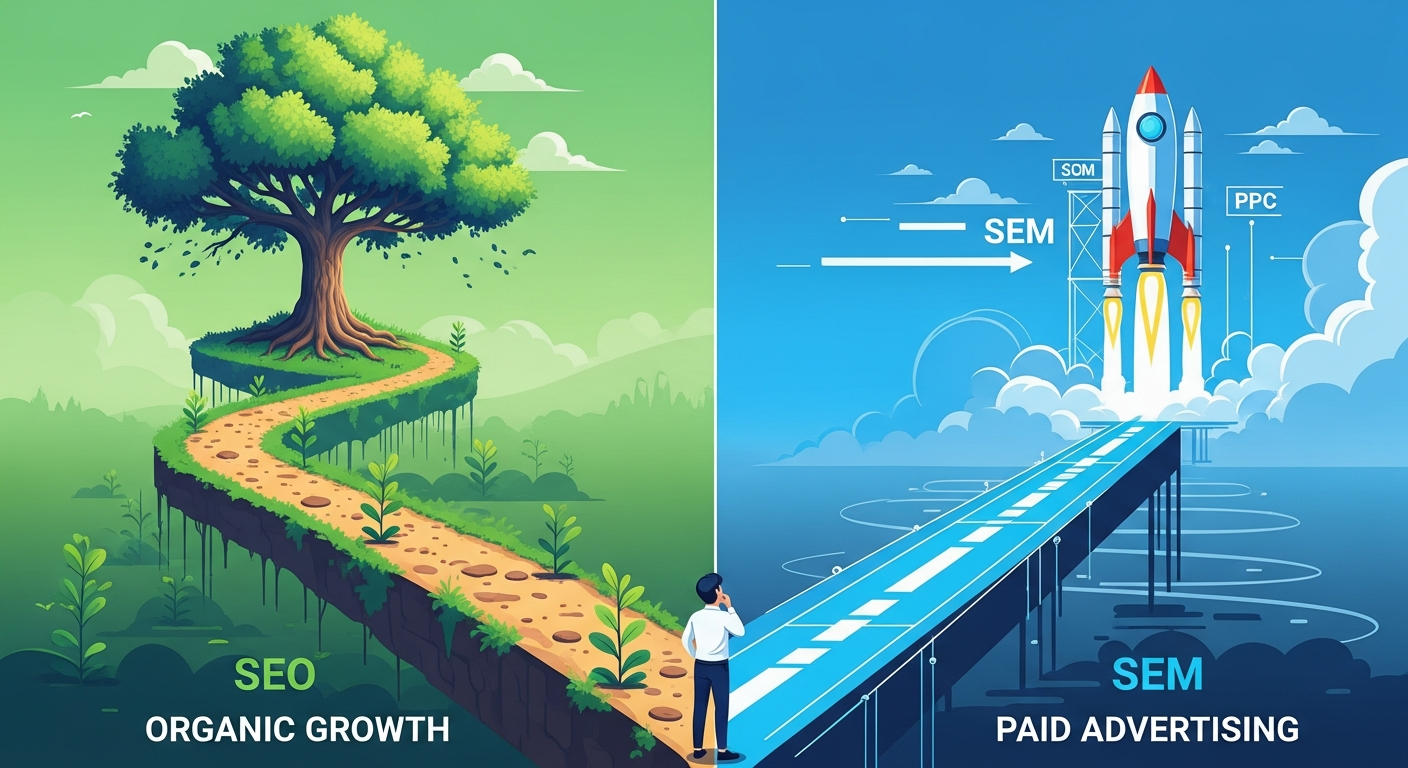
SEO vs SEM: Which Is Better for Small Businesses in 2026?
SEO vs SEM compared for small businesses. Cost, timeline, and ROI breakdown to help you choose the right strategy for your budget.
What Is SEO vs SEM? (Quick Definitions)
Search Engine Optimization (SEO) is the practice of optimizing your website and online presence to rank higher in organic (unpaid) search results. When someone searches for "best pizza near me" and your restaurant appears naturally in the results, that's SEO at work.
Search Engine Marketing (SEM), also known as Pay-Per-Click (PPC) advertising, involves paying for ads that appear at the top and bottom of search results. These are the listings marked with "Ad" or "Sponsored" that show up when people search for relevant keywords.
Think of it this way: SEO is like building a reputation over time—it takes patience but creates lasting results. SEM is like paying for a billboard on a busy highway—you get immediate visibility but pay for every person who sees it.
Both strategies aim to increase your visibility when potential customers search for products or services you offer. The key difference lies in how quickly you see results, how much control you have, and what it costs over time.
SEO vs SEM: Side-by-Side Comparison
| Factor | SEO | SEM (PPC) |
|--------|-----|-----------|
| Time to Results | 3-6 months for meaningful traffic | Immediate (within hours) |
| Monthly Cost | $500-2,500 for professional services | $1,000-5,000+ in ad spend |
| Setup Cost | $1,000-5,000 initial investment | $500-1,500 for campaign setup |
| Ongoing Effort | High (content, technical optimization) | Medium (campaign monitoring, optimization) |
| Sustainability | Long-term compound growth | Stops when you stop paying |
| Click Costs | Free once ranked | $1-50+ per click (varies by industry) |
| Trust Factor | High (organic results trusted more) | Medium (clearly marked as ads) |
| Measurability | Moderate (attribution challenges) | High (direct tracking) |
| Competition Impact | Gradual market share gains | Immediate competition for ad space |
| Control Level | Limited (algorithm dependent) | High (bid, budget, targeting control) |
| Best for | Long-term growth, brand building | Quick wins, promotions, testing |
“AI agents do in hours what teams used to do in weeks. The advantage compounds.”
When to Choose SEO
SEO makes the most sense for small businesses in specific situations. Understanding these scenarios can save you from making costly strategic mistakes.
You Have Time But Limited Ongoing Budget
If you're bootstrapping your business or have a tight monthly marketing budget, SEO often provides better long-term value. While the initial investment in professional SEO services might seem steep ($1,500-3,000 to start), the ongoing costs are typically lower than maintaining profitable PPC campaigns.
Consider Sarah, who owns a boutique accounting firm in Austin. She invested $2,500 in SEO optimization and now spends $800/month on ongoing SEO services. After 8 months, she ranks #2 for "small business accountant Austin" and gets 40+ qualified leads monthly without paying per click.
Your Industry Has High PPC Costs
Certain industries face brutal PPC competition. Legal services, insurance, financial services, and home services often see click costs exceeding $20-100. If you're in a high-cost industry, organic rankings become exponentially more valuable.
You Want to Build Long-Term Brand Authority
SEO isn't just about rankings—it's about becoming the trusted expert in your field. When you consistently appear in organic results for industry-related searches, you build brand recognition and trust that paid ads simply can't match.
Your Target Audience Actively Researches Before Buying
For businesses with longer sales cycles or higher-ticket items, SEO captures customers in the research phase. If your customers typically compare options, read reviews, and research extensively before purchasing, organic content marketing and SEO rankings are crucial.
You Have Interesting Stories to Tell
Some businesses naturally lend themselves to content creation. Restaurants can share recipes and food stories, fitness trainers can create workout guides, and home improvement companies can offer DIY tips. If you can create genuinely helpful content, SEO becomes much more effective.
Realistic SEO Timelines and Expectations
- Months 1-3: Technical optimizations, initial content creation, minimal traffic increases
- Months 4-6: Gradual ranking improvements, 25-50% traffic growth
- Months 7-12: Significant ranking gains, 100-300% organic traffic growth
- Year 2+: Market leadership potential, compound growth effects
When to Choose SEM (PPC)
SEM shines in different circumstances, particularly when speed and control are priorities. Here's when paid search makes more sense than organic optimization.
You Need Results This Quarter
If you're launching a new business, have immediate cash flow needs, or are testing a new market, SEM delivers results fast. You can literally launch campaigns in the morning and have qualified traffic by afternoon.
You Have a Proven Product with Good Margins
SEM works best when you know your numbers. If you know that every $100 in ad spend typically generates $300 in revenue, scaling SEM becomes a straightforward investment decision. Without this clarity, you're essentially gambling.
You're Running Time-Sensitive Promotions
Black Friday sales, seasonal promotions, limited-time offers, or event-based marketing campaigns require immediate visibility. SEO can't pivot quickly enough for time-sensitive campaigns.
You're Testing New Keywords or Markets
Before investing months in SEO for new product lines or geographic markets, smart businesses test demand with PPC campaigns. You can validate keyword volume, conversion rates, and customer acquisition costs before committing to longer-term SEO investments.
Your Local Competition Dominates Organic Results
If established competitors own the top organic spots in your market, PPC offers an immediate way to compete for visibility. This is particularly common in saturated local markets like real estate, dental practices, or auto repair shops.
You Want Precise Control Over Messaging and Targeting
SEM allows surgical precision in targeting. You can create different ads for different customer segments, test messaging variations, and adjust targeting based on performance data in real-time.
Realistic SEM Timelines and Expectations
Many agencies, including specialists like Findvex, recommend running PPC campaigns for at least 90 days to collect sufficient data for optimization decisions.
- Week 1: Campaign setup, initial data collection, high costs/low efficiency
- Month 1: Optimization based on performance data, improving cost-per-acquisition
- Months 2-3: Refined targeting, optimized ad copy, predictable performance
- Ongoing: Continuous optimization, seasonal adjustments, expansion to profitable keywords
The Hybrid Approach (Recommended)
Here's the uncomfortable truth most marketing articles won't share: the SEO vs SEM debate creates a false choice for most successful small businesses. The most effective approach typically combines both strategies strategically.
Why the Hybrid Approach Works
Immediate Coverage + Long-term Growth: SEM provides immediate visibility while SEO builds sustainable organic presence. This covers both your short-term business needs and long-term competitive positioning.
Data Sharing: PPC campaigns generate immediate keyword performance data that informs SEO strategy. You can identify high-converting keywords through paid campaigns, then target those same terms organically.
Market Domination: When you appear in both paid and organic results for the same search, you dramatically increase click-through rates and market share. Studies show combined visibility can increase total clicks by 89%.
Risk Mitigation: Algorithm updates can temporarily hurt organic rankings, while policy changes or increased competition can make PPC unprofitable. Diversifying across both channels reduces risk.
Smart Hybrid Implementation Strategies
Phase 1: Quick Wins (Months 1-3)
Phase 2: Optimization (Months 4-6)
Phase 3: Scaling (Months 7-12)
- Launch targeted PPC campaigns for your most important keywords
- Begin technical SEO foundation work
- Create initial content targeting long-tail keywords
- Use PPC data to validate keyword assumptions
- Optimize PPC campaigns based on conversion data
- Scale content creation around proven keywords
- Build backlinks and local citations
- Gradually shift budget toward best-performing channels
- Reduce PPC spend on keywords where you achieve strong organic rankings
- Expand PPC to new keywords and markets
- Leverage growing organic authority for competitive keywords
- Reinvest saved PPC budget into content marketing
Budget Allocation Guidelines
For most small businesses, an effective hybrid approach allocates budget roughly:
These percentages shift based on industry, competition, and individual business performance.
- 60% SEM, 40% SEO in months 1-6
- 40% SEM, 60% SEO in months 7-12
- 25% SEM, 75% SEO in year 2+ (as organic results mature)
Cost Breakdown for Small Businesses
Understanding the real costs helps you budget appropriately and set realistic expectations. These numbers reflect current market rates and typical small business needs.
SEO Investment Breakdown
Initial Setup Costs (One-time)
Monthly Ongoing Costs
- Website audit and technical optimization: $1,000-3,000
- Keyword research and strategy development: $500-1,500
- On-page optimization (10-20 pages): $1,000-2,500
- Local SEO setup (citations, Google Business Profile): $500-1,000
- Total Initial Investment: $3,000-8,000
- Content creation (2-4 blog posts): $800-1,600
- Link building and outreach: $500-1,000
- Technical monitoring and updates: $300-600
- Reporting and strategy adjustments: $200-500
- Total Monthly Investment: $1,800-3,700
SEM Investment Breakdown
Initial Setup Costs (One-time)
Monthly Ongoing Costs
- Account setup and campaign creation: $500-1,500
- Landing page creation/optimization: $1,000-3,000
- Conversion tracking implementation: $300-800
- Initial keyword research and competitor analysis: $500-1,000
- Total Initial Investment: $2,300-6,300
- Ad spend budget: $2,000-10,000+ (varies dramatically by industry)
- Campaign management and optimization: $500-2,000
- Landing page testing and updates: $300-800
- Reporting and analysis: $200-500
- Total Monthly Investment: $3,000-13,300+
Hidden Costs to Consider
SEO Hidden Costs
SEM Hidden Costs
- Website hosting and performance optimization: $50-200/month
- Premium SEO tools and software: $100-500/month
- Additional content creation for competitive keywords: $500-2,000/month
- Increased server costs from traffic spikes: $50-300/month
- Additional customer service for increased inquiries: $500-2,000/month
- Premium bidding and analytics tools: $100-800/month
Realistic ROI Expectations
Setting appropriate expectations prevents frustration and helps you make better strategic decisions. Here's what real small businesses typically see:
SEO ROI Timelines
Months 1-3: Investment Phase
Months 4-8: Growth Phase
Months 9-18: Acceleration Phase
18+ Months: Maturity Phase
- Expect to invest $5,000-15,000 with minimal direct returns
- Focus on foundation-building rather than immediate ROI
- Track ranking improvements and technical health scores
- Begin seeing 25-100% increases in organic traffic
- First significant leads from organic search
- ROI typically breaks even or slightly positive
- Organic traffic often grows 200-500% from baseline
- Strong positive ROI, typically 3:1 to 8:1 return
- Compound growth effects become apparent
- Market-leading organic visibility for target keywords
- ROI often exceeds 10:1 for successful campaigns
- Sustainable competitive advantages
SEM ROI Timelines
Month 1: Learning Phase
Months 2-3: Optimization Phase
Months 4-12: Scaling Phase
12+ Months: Maintenance Phase
- High costs, low efficiency as algorithms learn
- Expect negative ROI while optimizing campaigns
- Focus on data collection and conversion tracking
- Improved targeting and ad copy performance
- ROI typically reaches breakeven or modest positive
- Clear understanding of profitable keywords emerges
- Consistent positive ROI, typically 2:1 to 6:1 return
- Predictable customer acquisition costs
- Opportunities for geographic or keyword expansion
- Stable, predictable ROI with ongoing optimization
- Market share protection against competitive changes
- Integration with other marketing channels
Industry-Specific ROI Variations
Different industries see dramatically different ROI patterns:
High-ROI SEO Industries
Challenging SEO Industries
High-ROI SEM Industries
Challenging SEM Industries
- Professional services (legal, accounting, consulting): 8:1-15:1
- B2B software and technology: 6:1-12:1
- Specialized healthcare practices: 5:1-10:1
- Retail and e-commerce: 2:1-5:1 (high competition)
- Restaurants and food service: 3:1-6:1 (local-dependent)
- General contractors: 4:1-8:1 (seasonal variations)
- Emergency services (plumbing, HVAC repair): 3:1-8:1
- High-ticket B2B services: 4:1-10:1
- Specialized healthcare: 3:1-7:1
- Legal services: 1.5:1-3:1 (extremely high click costs)
- Insurance: 2:1-4:1 (heavy competition)
- Real estate: 2:1-5:1 (long sales cycles)
FAQs
How long does SEO take to show results?
Most small businesses see initial ranking improvements within 3-4 months, but significant traffic growth typically takes 6-8 months. The timeline depends heavily on your starting point, competition level, and implementation quality. Businesses starting with zero online presence need longer than those with existing websites and some authority.
The key is understanding that SEO works in phases. Early months focus on technical foundations and don't show dramatic traffic increases. Real growth accelerates in months 6-12 as content gains authority and rankings improve for competitive keywords.
What's a realistic monthly budget for PPC advertising?
For most small businesses, effective PPC campaigns require $2,000-8,000 monthly in ad spend, plus management costs. However, this varies dramatically by industry and location. Local service businesses might succeed with $1,000/month, while competitive industries like legal services might need $10,000+ monthly to compete effectively.
A useful rule of thumb: budget at least $50-100 per day in ad spend for meaningful results. Anything less typically doesn't provide sufficient data for optimization or meaningful market presence.
Can I do SEO myself or should I hire professionals?
Basic SEO tasks like writing quality content and optimizing page titles are manageable for motivated business owners. However, technical SEO, link building, and competitive strategy typically require professional expertise.
The honest answer depends on your time availability and learning appetite. DIY SEO can work for simple local businesses with limited competition, but most small businesses see better ROI hiring experienced professionals. Companies like Findvex often provide hybrid approaches where they handle technical work while you focus on content creation.
How do I know if my SEO or PPC campaigns are working?
For SEO, track:
For PPC, monitor:
Both strategies should ultimately drive business growth—more qualified leads, increased revenue, and better customer acquisition costs.
- Organic traffic growth (aim for 25-50% quarterly increases)
- Keyword ranking improvements for target terms
- Quality leads and conversions from organic search
- Local visibility improvements (Google Business Profile views)
- Cost per acquisition (should decrease over time)
- Conversion rates (should improve with optimization)
- Return on ad spend (aim for 3:1 minimum)
- Click-through rates and quality scores
What's the biggest mistake small businesses make with search marketing?
The most common mistake is expecting immediate results from SEO or giving
---
Ready to improve your search rankings? Get a free SEO audit at findvex.com/audit — no obligation, results in 48 hours.
FAQs
Ready to improve your search rankings? Get a free SEO audit at [findvex.com/audit](https://findvex.com/audit) — no obligation, results in 48 hours.
Findvex Team
Writes about SEO, AEO, and GEO for US small businesses at Findvex.
Related reads
Answer Engine Optimization (AEO): The 2026 Guide for Small Businesses
Learn answer engine optimization (AEO) in 2026. This practical guide helps small businesses get found in AI search, voice assistants, and answer engines.
SEOGenerative Engine Optimization (GEO): The 2026 Guide for Small Businesses
Learn how generative engine optimization helps small businesses get found in AI search. Our 2026 GEO guide covers strategies, tactics, and tips to boost visibility.
SEOSEO Agency in USA: AI-Powered SEO for Small Businesses | Findvex
Findvex is a leading SEO agency in USA delivering AI-powered SEO strategies that help small businesses rank higher, drive traffic, and grow revenue. Get started today.